


ePlane Company’s Electric Air Taxi: How a Chennai Startup Plans to Beat Traffic in Indian Cities
Anyone who has sat through an hour-long crawl across a congested Indian city has probably daydreamed about simply flying over it. A Chennai-based startup called The ePlane Company is trying to turn that daydream into a certified, flyable product. Incubated at the Indian Institute of Technology (IIT) Madras, the company is developing an electric air taxi that it says could cut a typical 60-minute road trip down to roughly 14 minutes in the air, at a fare not far removed from what commuters already pay for an Uber ride.
Who Is Behind The ePlane Company?
The ePlane Company was founded in 2019 by Satya Chakravarthy, an aerospace engineering professor at IIT Madras, along with IIT Madras alumnus Pranjal Mehta, who has since exited the venture. Chakravarthy is not new to deep-tech entrepreneurship in India. He has also been involved with space-tech startups Agnikul Cosmos and GalaxEye, as well as the hyperloop venture TuTr, which gives him a rare vantage point across multiple frontiers of Indian aerospace innovation.
The company’s legal name is Ubifly Technologies, a nod to its ambition of making flight as routine and accessible as calling a cab. Headquartered inside the IIT Madras Research Park in Chennai, the startup has grown from a small team working on drone technology into a company attempting to certify a full-scale electric vertical takeoff and landing, or eVTOL, aircraft.
Inside the e200x: A Compact eVTOL Built for Indian Cities
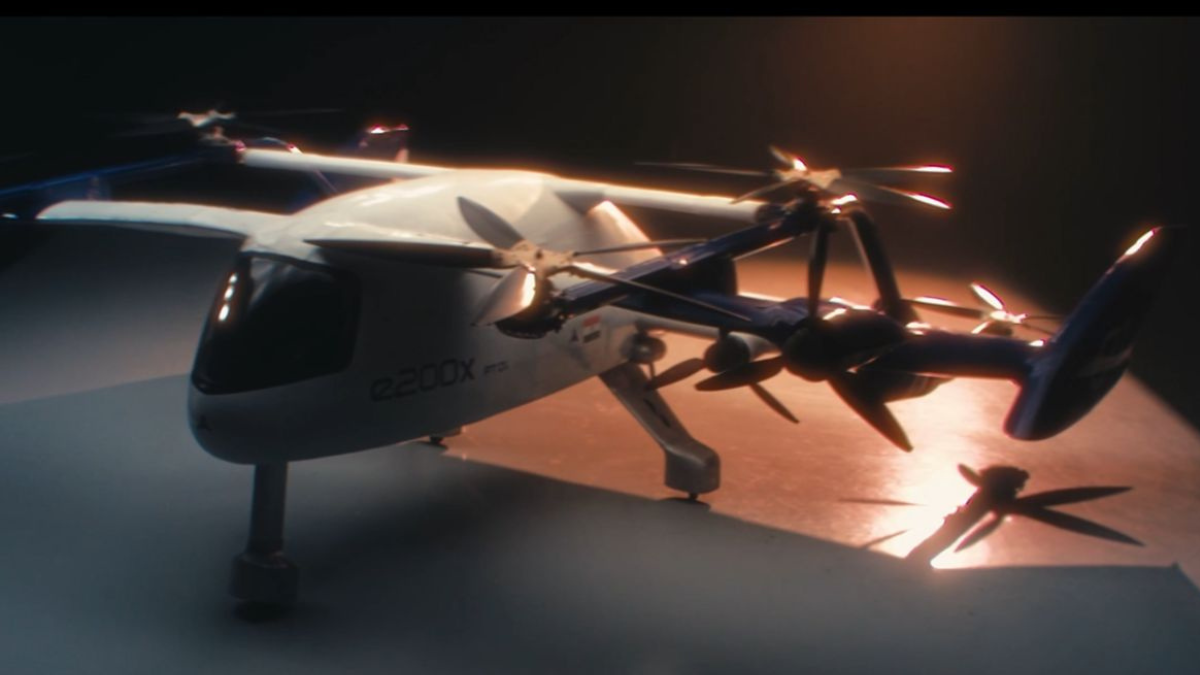
The core part of ePlane’s roadmap is the e200x, an all-electric aircraft designed specifically for short intra-city hops rather than long-haul travel. Unlike most global eVTOL designs, which typically carry a wingspan of 12 to 16 metres, the e200x has been engineered with a far more compact 8-metre wingspan and an overall footprint of around 8 by 10 metres. That smaller size is a deliberate choice, aimed at allowing the aircraft to take off and land from rooftops and tight urban spaces where a conventional helicopter or larger aircraft simply would not fit.
The aircraft relies on a technology the company calls synergistic lift, which keeps its vertical rotors active even during forward flight. This approach is meant to improve stability and efficiency while keeping the wings small enough for dense city use. On a single charge, ePlane says the aircraft should be capable of covering a range of roughly 110 to 200 kilometres at cruise speeds between 150 and 175 km/h, potentially completing dozens of short trips a day.
From Drones to Air Ambulances: The Commercial Roadmap
Rather than launching straight into passenger air taxi services, ePlane is following a staged commercialisation strategy that mirrors the approach taken by several eVTOL companies worldwide. The first phase involves commercial drones capable of carrying payloads between 2 and 6 kilograms, with a heavier-payload variant carrying up to 50 kilograms planned to follow, both able to fly distances of 40 to 60 kilometres.
The next and more significant phase centres on the eVTOL aircraft itself. ePlane’s initial commercial use case will not be ferrying office commuters but running air ambulance services, where speed can be a matter of life and death and the operational bar for approval is comparatively more manageable than full public passenger transport. Airport transfers and broader urban passenger services are expected to follow once the technology and regulatory framework mature.
Certification Timeline and Regulatory Progress
Building a flying vehicle is one challenge; getting it certified to carry people is another altogether. ePlane has already secured Design Organisation Approval from India’s Directorate General of Civil Aviation (DGCA) for aircraft in the 2 to 19 seater category, making it the first private entity in India to receive this approval. The Type Certification process for the e200x is also underway, with the DGCA having accepted the company’s application.
According to the company, a certifiable prototype is expected within the near term, after which it will likely take a couple of additional years to secure full DGCA certification. ePlane has indicated it is targeting operational readiness for its air-ambulance variant around 2027-28, with commercial passenger services expected to follow later in the decade as certification and infrastructure catch up with the technology.
Funding and the Broader Race for India’s Skies
ePlane (Air Taxi) has raised more than $20 million across multiple funding rounds, including a Series B round co-led by Speciale Invest and Singapore-based Antares Ventures. The company is reportedly in discussions to raise a larger round combining equity, convertible instruments, and government-backed research support, underscoring investor appetite for urban air mobility as a category in India.
It is not alone in this pursuit. InterGlobe Enterprises, the parent company behind IndiGo, has partnered with US-based Archer Aviation to explore an all-electric air taxi service in India, signalling that established aviation players are also placing early bets on this space. Globally, companies across the United States, Europe, and China are racing to bring eVTOL aircraft to market, hoping to solve the same basic problem that plagues nearly every major city: too many vehicles, not enough road.
What This Means for Everyday Commuters
For now, electric air taxis remain a demonstration of what is possible rather than a service anyone can book. Certification, infrastructure such as rooftop landing pads, air traffic integration, and public trust in autonomous or semi-autonomous flight will all need to fall into place before city-dwellers can realistically swap their cab booking app for a flight booking one.
Still, the progress from a two-founder idea at an IIT Madras lab to a Type Certification application with India’s aviation regulator marks a genuine milestone for the country’s urban air mobility ambitions. If ePlane and its peers deliver on their timelines, the next decade could see Indian cities where beating traffic no longer means leaving earlier, but flying instead.

