


Connect with us

News & Updates

IndiGo Invests in Sarla Aviation: Why India’s Biggest Airline Is Backing Flying Taxis

IndiGo Ventures announces major investment in Sarla Aviation eVTOL startup. India’s biggest airline backs flying taxi technology for Indian cities. Strategic move signals India’s commitment to aviation innovation.

Published

on

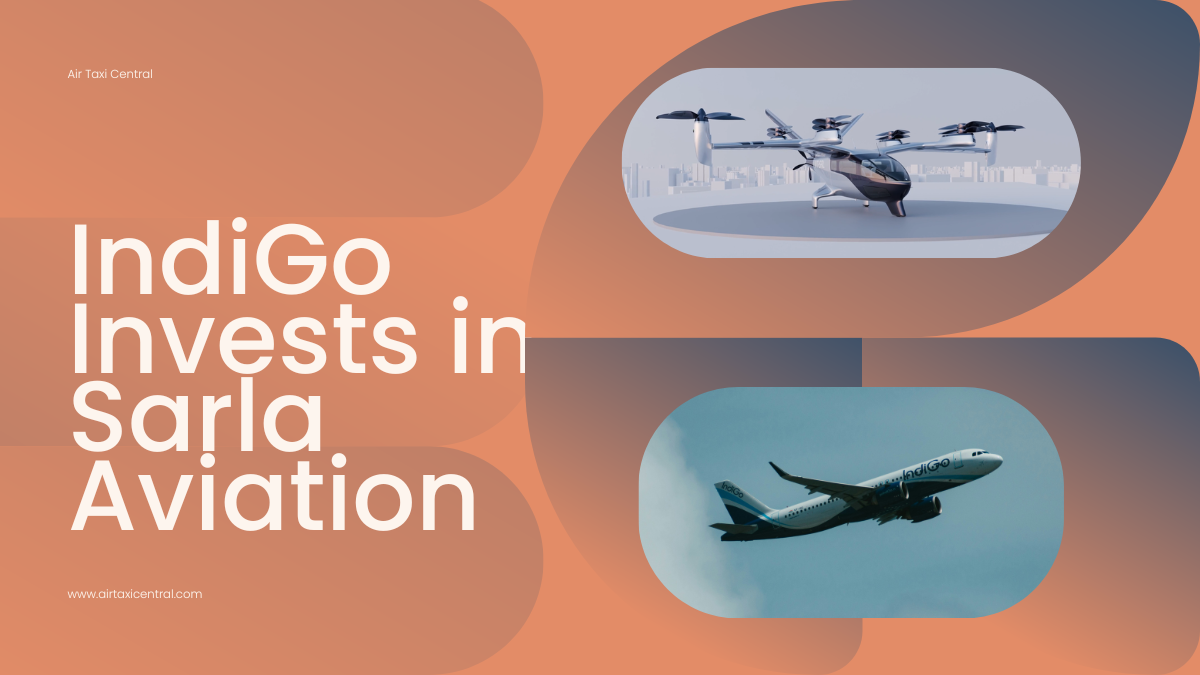
IndiGo Invests in Sarla Aviation

In India the biggest airline has just confirmed officially about a huge investment on the upcoming flying/air taxis. The company has officially announced that its venture capital arm, IndiGo Ventures, is investing in Sarla Aviation. Sarla Aviation is an Indian startup building electric vertical takeoff and landing aircraft (eVTOL).

This is not a small investment. This is a major strategic move. It says India is serious about becoming a player in the global flying taxi market.

IndiGo Ventures Announces Strategic Investment in Indian eVTOL Startup Sarla Aviation

Why This Matters (Three Key Things)

First thing: All we need to understand is IndiGo is not just an airline, its India’s leader in commercial aviation. If the company is all set to invest in eVTOL, it signals confidence that flying taxis are real.

Second thing: India is building its own eVTOL ecosystem. Instead of importing flying taxis from America or Europe, India is creating homegrown solutions. That’s strategically important.

Third thing: This investment will accelerate Sarla Aviation’s development –  Money, Resources and Airline expertise.

India’s skies are about to get a lot quieter—and much more electric. IndiGo, the country’s dominant airline, is putting its massive weight behind Sarla Aviation, a homegrown startup building electric vertical takeoff and landing (eVTOL) aircraft.

This isn’t just a small side project; it’s a strategic move by a company that currently defines how India flies. Here is everything you need to know about the players involved and why this partnership is a big deal for the future of travel.

Who is IndiGo?

If you have flown within India, you’ve likely stepped onto an IndiGo plane. Based in Delhi and founded in 2006, IndiGo has grown into a global powerhouse over the last two decades.

  • Market Leader: It is the largest airline in India by passenger volume.
  • Massive Fleet: They operate over 300 aircraft and serve more than 75 domestic cities.
  • Proven Success: With over 60 million passengers annually, they aren’t just a “budget airline”—they are a profitable, publicly traded giant that understands the Indian market better than anyone else.

Why their involvement matters: When a company of this scale invests in electric flight, it adds instant credibility. IndiGo brings nearly 20 years of experience in safety regulations, complex operations, and government relations that a startup simply doesn’t have yet.

Who is Sarla Aviation?

Sarla Aviation is a bold Indian startup aiming to solve one of the country’s biggest headaches: urban traffic. Instead of sitting in a car for two hours to cross Bengaluru or Mumbai, Sarla wants you to fly over it.

  • The Mission: Developing fully electric aircraft that take off and land like a helicopter but fly like a plane.
  • The Focus: Unlike some global competitors targeting luxury “private jet” crowds, Sarla is focusing on affordability and making urban air mobility accessible for regular commuters.
  • India-First Design: Their aircraft are being built specifically to handle India’s unique weather conditions and infrastructure needs.
A Strategic Advantage

Sarla Aviation is currently in the development phase, meaning they are still refining their prototypes and haven’t started mass production. This is where IndiGo comes in.

By partnering with Sarla, IndiGo can provide more than just money. They offer a “masterclass” in how to run an aviation business. From navigating India’s strict aviation laws to preparing for commercial operations, IndiGo is the ultimate mentor.

Fact Check: While IndiGo was founded in 2006, it reaches the 20-year milestone in 2026. Regardless of the exact anniversary, they remain the most influential force in Indian aviation today.

Why they matter:

Most eVTOL companies are American or European. Companies like Joby, Archer, and Lilium are building for American and European markets.

Sarla Aviation is different and the company is building for India. It means:

  • Aircraft designed for Indian weather
  • Aircraft meeting Indian regulations
  • Aircraft affordable for Indian market
  • Aircraft optimized for Indian cities

This is important. India has unique needs. Indian weather is different. Indian regulations are different. Indian budgets are different.

The Investment: More Than Just a Check

While the exact financial details of the deal haven’t been fully disclosed, IndiGo Ventures has described this as a “significant” strategic investment. In the world of aviation startups, this likely puts the funding in the multi-million dollar range, providing Sarla Aviation with the runway they need to move from design to physical testing.

IndiGo’s reasons for jumping in now are clear:

  • Strategic Positioning: Urban air mobility is no longer a “maybe.” IndiGo wants a front-row seat as the eVTOL market takes off.
  • Homegrown Innovation: By backing Sarla, IndiGo is ensuring that India doesn’t have to rely on foreign tech. This is about building an Indian solution for Indian skies.
  • Seamless Connections: Imagine landing at an airport and immediately hopping into an electric taxi to your office. The potential for “multi-modal” travel—where your airline ticket and air taxi are part of the same journey—is the ultimate goal.

Why India is the Perfect Proving Ground

India isn’t just another market; it is perhaps the best place on Earth for flying taxis to succeed. Our cities face unique challenges that traditional cars and trains simply can’t solve fast enough.

Several factors make India an eVTOL goldmine:

  • Beating the Traffic: Cities like Delhi and Mumbai are famous for gridlock. Vertical takeoff removes the “road” from the equation entirely.
  • Tech & Manufacturing: With a massive pool of engineering talent and a growing manufacturing sector, India has the “brain power” to build and maintain these complex machines locally.
  • Government Support: Policy shifts are making it easier for drone and eVTOL startups to test and operate, showing that the regulatory wind is blowing in the right direction.

Major hubs like Bengaluru, Hyderabad, and Pune—cities with high-income tech populations and expanding borders—are expected to be the first to adopt these “sky commutes.”

When Can You Book a Flight?

We are closer than you might think. While global cities like Dubai are aiming for launches in late 2026, India’s timeline is following a realistic but ambitious path. Based on current development and testing phases, here is what the roadmap looks like:

  • 2027–2028: Intensive testing and prototype flight trials across Indian cities.
  • 2028–2029: Finalizing regulatory approvals with aviation authorities.
  • 2029–2030: The first commercial routes are expected to go live in major metros.

Within the next three to four years, the sound of electric rotors over our cities could become a common reality. Thanks to the partnership between a giant like IndiGo and a pioneer like Sarla Aviation, India is well-positioned to lead the electric revolution in the air.

Indian eVTOL Companies Landscape

Sarla Aviation is not alone.

Other Indian eVTOL startups:

Sarla Aviation:

  • Building passenger eVTOL
  • Just got IndiGo investment
  • Momentum accelerating

Hatzolah Aviation:

  • Building emergency medical eVTOL
  • Focus on healthcare transport
  • Partnership with hospitals

Other startups:

  • Several others in stealth mode
  • Many in early development
  • Some partnering with foreign companies

Market Competition

This investment puts pressure on other eVTOL companies.

Global eVTOL leaders:

Regulatory Path Forward

How will Sarla Aviation get approved in India?

India’s aviation regulator:

The Directorate General of Civil Aviation (DGCA) oversees aircraft certification in India.

Certification requirements:

Sarla Aviation will need to certify their aircraft as:

  1. As an aircraft – Meet airworthiness standards
  2. For the route/operation – Meet operational requirements
  3. With qualified crew – Pilot licensing and training

This is similar to how FAA certification works in the USA, but following Indian regulations.

Timeline for certification:

Based on global experience:

  • Application to DGCA: 2027-2028
  • Certification process: 1-2 years
  • First commercial approval: 2029-2030

Vision for India’s Flying Taxi Future

IndiGo and Sarla Aviation’s vision:

What they’re probably envisioning:

By 2030:

  • Sarla Aviation aircraft flying in Delhi, Mumbai, Bangalore
  • IndiGo operating some routes (code-sharing or partnership)
  • Thousands of people flying eVTOL monthly
  • Multiple vertiports in major cities
  • Established network of flying taxi routes

By 2035:

  • Flying taxis commonplace in Indian cities
  • 50,000+ people flying monthly
  • Expansion to secondary cities
  • International routes (India to neighboring countries)
  • Cargo delivery via eVTOL
  • Emergency medical transport network

By 2040:

  • Flying taxis are normal transportation
  • India a global leader in eVTOL technology
  • Multiple Indian manufacturers
  • Export of aircraft to other countries
  • Sarla Aviation a major global player

My (Amit’s) prediction:

Sarla Aviation will succeed. The combination of IndiGo’s backing, India’s market need, and capable founders is powerful.

Timeline:

  • 2029: First commercial flights (probably)
  • 2030-2035: Rapid expansion across India
  • 2035+: Sarla Aviation becomes established player

Bigger Picture: India’s Innovation Ecosystem

This investment is bigger than just eVTOL.

It signals something important about India: India is not just consuming technology anymore. India is creating technology.

Examples:

  • Software/IT: Infosys, TCS, Wipro (global leaders)
  • Smartphones: Indians using apps others created
  • Now: eVTOL aircraft – India building it, not importing

What this means:

India’s innovation ecosystem is getting better – entrepreneurs,, capital and solutions are on great pace. IndiGo’s investment in Sarla Aviation shows Indian companies have confidence in home country startups.

This will inspire more innovation, startups and competition. Also the better products.

India is becoming a technology leader, not just a market.

What This Means for You

If you live in India:

Within 5 years, you might be flying a Sarla Aviation eVTOL from Delhi airport to your office. This investment brings that future closer.

If you invest in aviation:

Sarla Aviation is now a company to watch. Not just locally. Globally. Indian companies can compete with American and European manufacturers.

If you care about urban air mobility:

India’s market is 1.4 billion people. If flying taxis succeed in India, that’s massive. More scale. Lower costs. Faster adoption worldwide.

If you work in aviation:

Jobs coming. Sarla Aviation will need engineers, designers, technicians, pilots, maintainers. Career opportunities in India’s aviation future.

Conclusion

The dream of “flying taxis” in India is moving out of science fiction and into reality. With IndiGo’s operational muscle and Sarla Aviation’s electric tech, the goal of clean, quiet, and affordable city travel is closer than ever.

Questions About eVTOL and India?

Email us: contact@airtaxicentral.com or amit@airtaxicentral.com

Follow us:

  • Twitter: @AirTaxiCentral
  • Instagram: @airtaxicentral
  • YouTube: @AirTaxiCentral

News & Updates

Honda Flying Car Just Took Its First 90-Second Flight in California

Published

on

Honda Flying Car

Honda achieved a major milestone in California by successfully testing its new 7,000-pound hybrid air taxi for a 90-second flight.

Unlike competitors who are rushing to launch all-electric aircraft, Honda took a slow and steady approach. The company has officially conducted 400 smaller test flights before finally building and launching this full-sized model on April 1, 2026, in San Luis Obispo.

The aircraft features a unique design built for safety. It uses eight top propellers to handle vertical takeoffs and landings, and two rear propellers to drive it forward. Honda deliberately avoided using parts that tilt or shift roles. The officials believe keeping the lifting and driving systems separate is much safer, ensuring the aircraft has reliable backups while flying high in the sky.

Why the Hybrid Setup is a Game Changer

Instead of relying only on batteries, Honda put a small gas-turbine generator inside the aircraft to work alongside the battery pack. This combo powers ten different electric motors.

Most all-electric flying taxis can only travel about 60 miles before they need to plug in and recharge. Because of that limitation, they are mostly good for short trips, like a quick shuttle from downtown to the local airport.

Honda’s hybrid system completely changes the game. It can fly up to 250 miles on a single trip. That means you can actually travel between major cities—like flying all the way from New York City to Boston.

Honda Flying Car

Here is how it works in plain English:

Taking off and landing: This requires a ton of energy. Both the gas generator and the batteries work together to push maximum power to the motors.

Cruising in the air: Once the aircraft is flying smoothly, the gas generator takes over and can even recharge the batteries while you fly.

Essentially, you get the quiet efficiency of electric motors combined with the long-distance power of a gas engine. The only downside is that it still burns fuel, but Honda looks at this as a temporary stepping stone until battery technology gets better in the future.

Getting to Market: Safety Over Speed

Honda isn’t trying to rush this to the public. While other companies promise they will be flying passengers by the late 2020s, Honda is aiming for the early 2030s to get official approval from safety regulators.

This slower timeline makes a lot of sense. Honda’s hybrid system is complicated, and the company refuses to cut corners when it comes to safety. They learned a valuable lesson from the electric car industry: if you make big promises about dates you can’t keep, you just end up letting customers down when things get delayed. Honda believes it is much better to take your time and get it right, especially when you are building something that carries people high in the sky.

This successful test flight comes at the perfect time. Right now, the aviation world is realizing that pure electric flying cars just can’t fly very far. Honda is betting that passengers will care much more about long-distance travel than which company finishes first—and this latest test proves their big idea actually works.

Continue Reading

Market & Investment

Flying Taxi Market Worth $9.53 Billion by 2030: The Future of Urban Mobility

Traffic is moving to the skies. Thanks to big investments, smart flight software, and the push for green travel, electric flying taxis are quickly becoming a reality. Discover why this new market is booming and how it will soon change the way we commute through our cities.

Published

on

Flying Taxi Market Worth $9.53 Billion by 2030

Urban transportation is shifting from crowded city streets to the skies. Cities around the world face growing traffic problems and need cleaner travel options.

Because of this, electric vertical takeoff and landing (eVTOL) aircraft are moving closer to reality. According to the latest reports the global flying taxi market will reach a value of $9.53 billion by the year 2030. This growth represents a massive 21.1% compound annual growth rate (CAGR) over the next few years.

Why Flying Taxis Are Growing So Fast

There are a few main reasons why this new market is growing so quickly. First, big companies are spending a lot of money to build these electric aircraft. Second, new computer programs are making flights much safer. These smart systems can fly the aircraft on their own, so companies will not need to find and hire as many highly trained pilots.

People also want cleaner ways to travel. Because these air taxis run on electricity, they do not produce dirty exhaust smoke, which helps keep city air clean. To make this all work, companies are building special landing pads where these taxis can take off and land safely. At the same time, governments are writing clear safety rules to make sure these flying taxis are completely safe for everyday passengers to use.

Flying Taxi Market Worth $9.53 Billion by 2030

Flying Taxi Market Worth $9.53 Billion by 2030

Major Industry Players Leading the Race

The flying taxi industry features a mix of aerospace giants and modern technology firms. Major businesses working in this space include Hyundai Motor Company, The Boeing Company, Airbus SE, and Zhejiang Geely Holding Group. Other names helping to push this technology forward include Textron Inc., Vertical Aerospace, Archer Aviation, Joby Aviation, Wisk Aero, Volocopter, and Ehang Holding Limited.

Instead of working completely alone, these industry leaders are joining forces with software experts. For example, the Indian aviation startup ePlane signed a partnership with Tata Consultancy Services. The ePlane Company wants to use the computing, data analytics, and digital tools from Tata Consultancy Services to optimize battery life and improve passenger routes across major cities.

Key Trends: From Commuter Shuttles to Firefighting Vehicles

As the market grows, companies are finding creative ways to use electric aircraft. While most people think of flying taxis as simple passenger shuttles, these vehicles are also being designed for emergency rescue missions.

Hyundai Motor Company has been a major highlight in this sector through its advanced air mobility division, Supernal. At major trade shows, Supernal showcased its impressive S-A2 electric flying taxi prototype. The Supernal S-A2 is an eight-rotor vehicle designed to cruise quietly at 120 miles per hour.

It targets short city trips to help people skip heavy ground traffic completely. Other international startups are taking similar designs and building high-payload versions meant to carry heavy equipment to fight fires in hard-to-reach areas.

How the Flying Taxi Industry is Segmented

The global industry is split into distinct categories depending on the needs of different cities:

  • By Seating Capacity: Single-seat aircraft for personal travel, double-seat vehicles for short commutes, and multi-seat designs for public air shuttle services.
  • By Aircraft Design: Multicopters and quadcopters that use multiple rotors to lift off vertically without needing a long runway.
  • By Power Source: Pure electric battery systems, parallel hybrid engines, and turboelectric propulsion.
  • By Travel Distance: Intracity flights to move across a single metropolitan area, and intercity flights to connect neighboring cities.

With massive financial backing and constant improvements in battery technology, flying taxis are no longer a concept from science fiction. The next few years will determine how quickly these electric aircraft become a regular part of daily city transit.

Continue Reading

Company Analysis

Wisk Aero Gen 6: Why This Pilotless Air Taxi Will Beat Joby and Archer

While most flying taxi companies are putting a human pilot in the driver’s seat, Wisk Aero is doing something totally different: their air taxi has no pilot at all. Wisk is playing a smart, patient long game, and they just hit a massive milestone by flying two of their 6th-generation self-flying aircraft at the exact same time. This article breaks down how the new aircraft works, the layers of safety technology keeping it in the air, and why its cheaper running costs could help Wisk beat out rivals like Joby and Archer by 2030.

Published

on

Wisk Aero Gen 6

Most air taxi companies are building aircraft with a pilot inside. Wisk Aero is doing something completely different. Wisk is building a flying taxi that has no pilot at all — not in the cockpit, not remotely controlling it in real time. The aircraft flies on its own, with a human operator on the ground keeping an eye on things.

This is the Wisk Aero Generation 6, also called the Gen 6. And in May 2026, Wisk reached a milestone that very few eVTOL companies have hit: two fully autonomous aircraft flying at the same time in an active flight test program.

Here is everything you need to know about the Gen 6, what makes it different, and why this aircraft could change the way cities think about transportation.

Table of Contents

  1. What Is the Wisk Aero Gen 6?
  2. Two Aircraft, One Goal: Inside Wisk’s Dual-Flight Test Program
  3. Gen 6 Specs: What This Aircraft Can Actually Do
  4. No Pilot Inside — How Does That Actually Work?
  5. Where Does FAA Certification Stand Right Now?
  6. Texas Is the First Market — Here Is the Plan
  7. Wisk Gen 6 vs. Joby, Archer, and Others
  8. When Can You Actually Ride One?
  9. Final Thoughts

What Is the Wisk Aero Gen 6?

Wisk Aero is a company based in Mountain View, California. Wisk is fully owned by Boeing, one of the largest aircraft manufacturers in the world. Wisk has been working on autonomous flying taxis for over a decade.

The Gen 6 is the sixth aircraft Wisk has ever built — and the first one being put forward for FAA type certification. That means this is not a prototype or a test concept. This is the real product that Wisk wants to certify and put into commercial passenger service.

Before the Gen 6 was even built, Wisk had already completed more than 1,750 test flights across its previous five generations of aircraft. All of that data went into designing the Gen 6. No other eVTOL company in the world has flown six generations of the same aircraft type.

Quick Fact: The first Gen 6 aircraft made its maiden hover flight on December 16, 2025, at Wisk’s test facility in Hollister, California. The aircraft followed a pre-programmed flight plan — no human was flying it.

Two Aircraft, One Goal: Inside Wisk’s Dual-Flight Test Program

On May 4, 2026, Wisk tested its second Gen 6 aircraft for the first time. The flight took place at Wisk’s flight test facility in Hollister, California. The aircraft, registered as N607WA, completed vertical takeoff, hover, and what engineers call “chirp” maneuvers. These are controlled movements that help measure how the aircraft’s structure handles different loads and how the flight controls respond.

This happened just four and a half months after the first Gen 6 flew in December 2025. Most eVTOL companies take much longer to build and fly a second aircraft.

Wisk CEO Sebastien Vigneron said: “Seeing the second Gen 6 aircraft take to the skies is a proud moment for Wisk. This pace of execution is exactly what is required to meet the rigorous safety standards of commercial aviation. Having multiple aircraft in flight testing allows us to move faster, learn quicker, and stay on the leading edge of autonomous aviation. Every flight provides crucial data that matures our aircraft and autonomous system, bringing us one step closer to delivering a certified, autonomous air taxi service.”

Wisk Aero Gen 6

Wisk Aero Gen 6 (Image Credit: wisk.aero)

This increase in flight test capacity directly supports Wisk’s path to commercialization, along with the U.S. Department of Transportation’s selection of Wisk’s partner, the Texas Department of Transportation (TxDOT), for the Electric Vertical Takeoff and Landing (eVTOL) and Advanced Air Mobility (AAM) Integration Pilot Program (eIPP). Wisk will use its autonomous systems and aircraft to drive the program’s operational execution, conducting real-world flight operations in the U.S. National Airspace.

Why does having two aircraft matter so much? Because FAA certification is driven by data. The more flights Wisk completes, the more data Wisk collects. The more data Wisk collects, the faster Wisk can prove to the FAA that the aircraft is safe. With two aircraft flying at the same time, Wisk can now run parallel test campaigns — effectively doubling the speed at which Wisk builds its certification case.

Gen 6 Specs: What This Aircraft Can Actually Do

The Gen 6 is not just impressive because it flies itself. The technical specs are genuinely competitive with every other air taxi being developed right now.

SpecDetail
Passengers4 passengers + luggage
Cruise Speed120 knots (138 mph / 222 km/h)
Range90 miles (145 km)
Service Altitude2,500 to 4,000 feet
Wingspan50 feet (15 metres)
Propellers12 total — 6 lift rotors, 6 convertible lift/cruise rotors
Battery120 kWh
Charging Time15-minute fast DC charge
PilotNone onboard — fully autonomous
Transition to Forward FlightApproximately 30 seconds

The wing spans 50 feet and sits in a high position on the aircraft. This gives the aircraft more stability and also improves the view for passengers inside. The cabin is designed to feel like a premium car interior — comfortable seats, good window visibility, Wi-Fi, and charging ports.

The 15-minute fast charge is a standout feature. Most electric aircraft take much longer to recharge. If Wisk can maintain this in commercial operations, the Gen 6 can complete multiple short trips per day without long gaps between flights. That is important for making the economics of an air taxi service actually work.

No Pilot Inside — How Does That Actually Work?

This is the part that makes Wisk Aero different from every other major air taxi company in the United States right now. Companies like Joby Aviation, Archer Aviation, and Beta Technologies are all building aircraft where a human pilot sits in the cockpit. Wisk is building an aircraft where no one sits in the cockpit — because there is no cockpit.

So how does the Gen 6 fly safely?

The aircraft uses a combination of advanced computers, sensors, radar, and software to navigate its route. The Gen 6 follows pre-programmed flight paths and can detect and avoid other aircraft on its own. A ground-based operator called a Multi-Vehicle Supervisor monitors the flight and can take control if needed. One operator on the ground can supervise multiple aircraft at the same time.

The safety systems are built in layers. The Gen 6 has triple-redundant autonomous flight systems, 12 independent electric motors, and a whole-airframe parachute for emergency situations. If any single system fails, a backup takes over immediately.

Wisk Vice President of Certification Cindy Comer explained the reasoning behind this approach: “We know that eventually, to scale, this industry needs to have autonomy. We could build an aircraft and put pilots in it, and then later go autonomous. But that would mean certifying twice.” Wisk chose to certify autonomy from the very beginning.

Where does the official safety approval stand?

Getting the Federal Aviation Administration (FAA) to clear these air taxis for paying passengers is the hardest part of the whole business. It takes a massive amount of time, paperwork, and money. But the company is actually much further along than most people think.

Right now, they are in the deep testing phase. Instead of just showing the government plans on paper, Wisk is using real flight data to prove that their 6th-generation aircraft is completely safe to fly in any kind of weather or situation. This is a big deal because it is the first time in U.S. history that an aircraft with no pilot onboard is trying to get certified for passengers. Because this has never been done, there is no official rulebook yet.

Wisk is actually helping the FAA and NASA write the safety rules for the future. To do this, they are flying two test aircraft to push the boundaries—taking them faster, higher, and through tougher maneuvers. Their biggest focus right now is perfecting the trickiest part of the flight: smoothly changing from hovering like a helicopter to flying fast like an airplane.

Texas Is the First Market — Here Is the Plan

In March 2026, the U.S. Department of Transportation selected the Texas Department of Transportation (TxDOT) for the FAA’s eVTOL Integration Pilot Program, known as the eIPP. Wisk Aero was named as TxDOT’s primary private-sector eVTOL partner.

The eIPP is a White House-backed program that allows eVTOL aircraft to begin real-world operations in live U.S. airspace — even before full FAA type certification is complete. This means Wisk can start collecting real operational data while the certification process is still ongoing.

Houston is Wisk’s primary launch market. Los Angeles and Miami are also planned for later expansion.

The Texas program will run in phases. In the first phase, Wisk will operate conventional piloted aircraft on eVTOL routes. This lets Wisk test the route infrastructure, airspace integration, and its SkyGrid airspace management platform — all before the Gen 6 starts flying passengers. In the advanced phase, operations will scale to the Gen 6 aircraft itself, giving the FAA high-frequency data to support final certification.

Wisk’s subsidiary SkyGrid provides the Strata airspace management platform. This software helps manage the flow of autonomous aircraft in shared airspace — a critical part of making autonomous air taxis safe in busy city skies.

Wisk Gen 6 vs. Joby, Archer, and Others

It is fair to ask: how does the Gen 6 compare to the competition?

CompanyAircraftPilotPassengersSpeedTarget Launch
Wisk AeroGen 6No pilot (autonomous)4138 mph2030
Joby AviationS41 pilot4200 mph2026
Archer AviationMidnight1 pilot4150 mph2026
Beta TechnologiesALIA1 pilot5170 mph2026–2027

Joby, Archer, and Beta Technologies are all targeting commercial service much sooner — in 2026 or 2027. Wisk is targeting 2030. But the trade-off is significant. Joby, Archer, and Beta still need a human pilot for every single flight. Wisk does not.

A piloted air taxi has one major limitation: you always need a trained, certified pilot. That costs money and limits how fast a company can scale its service. An autonomous air taxi removes that constraint entirely. One ground operator can oversee multiple aircraft at once. Over time, this makes autonomous air taxis far cheaper to operate than piloted ones.

Wisk’s bet is that being the first to certify autonomous flight will give the company a long-term advantage that no piloted air taxi company can easily match or copy.

When Can You Actually Ride One?

Wisk has set a commercial service target of 2030. That is four years from now. The timeline makes sense when you understand how much testing is still ahead.

The current flight test program is working through the transition corridor — the phase where the aircraft moves from hovering to flying like a fixed-wing plane at full cruise speed. This is technically demanding and requires a large amount of data before the FAA is satisfied.

After flight envelope testing is complete, Wisk still needs to complete certification compliance testing, manufacturing certification, and air carrier certification. Each step requires a separate FAA approval.

The eIPP Texas program runs in parallel. If real-world operations in Texas go well, it could build the FAA’s confidence in the Gen 6 and shorten the overall path to full certification. Houston will likely be the first city where paying passengers can board a Gen 6, with Los Angeles and Miami to follow.

Wisk has not confirmed ticket pricing yet, but the long-term goal is to make air taxi rides competitive with rideshare prices as the fleet scales up and operational costs come down.

Amit’s Opinion

While a 2030 launch target might make Wisk look like a laggard compared to Joby or Archer’s 2026 timelines, playing the long game is actually Wisk’s greatest strength.

By skipping the intermediate “piloted” phase, they are absorbing massive regulatory friction upfront so they don’t have to redesign and re-certify an entirely new system later.

The recent addition of a second Gen 6 test vehicle shows they have the capital and discipline to brute-force the data collection the FAA demands.

In the end, the commercial winner won’t be the company that flies passengers first—it will be the company that scales first. Without the burden of pilot wages and pilot shortages, Wisk’s unit economics are going to be incredibly tough for competitors to match when 2030 rolls around.

Final Thoughts

Wisk Aero is not the fastest company in the air taxi race. Joby and Archer are already doing public demonstration flights in New York City and targeting service launches this year. Wisk will not have a commercial product until 2030.

But Wisk is playing a completely different game.

Every other major eVTOL company in the United States is building a next-generation helicopter with a quieter engine and a pilot in the seat. Wisk is building something that has never existed before: a fully autonomous passenger aircraft certified to commercial aviation safety standards.

The Gen 6 is not just a new type of vehicle. It is potentially a new category of aviation altogether.

The fact that two Gen 6 aircraft are now flying simultaneously — just a few months after the first one left the ground — shows that Wisk is executing at a serious and disciplined pace. Boeing’s backing gives Wisk the financial strength to see this through a certification process that could take several more years.

If Wisk succeeds, the air taxi industry looks very different. The cost of operating an air taxi service drops dramatically when you remove the pilot from the equation. That changes the economics of the entire industry — not just for Wisk, but for every company that follows.

That is why the Gen 6 matters. Not because it will fly passengers next month. But because it is the aircraft that could prove autonomous air travel is possible — and in doing so, change everything that comes after it.

Continue Reading
Advertisement

Trending
