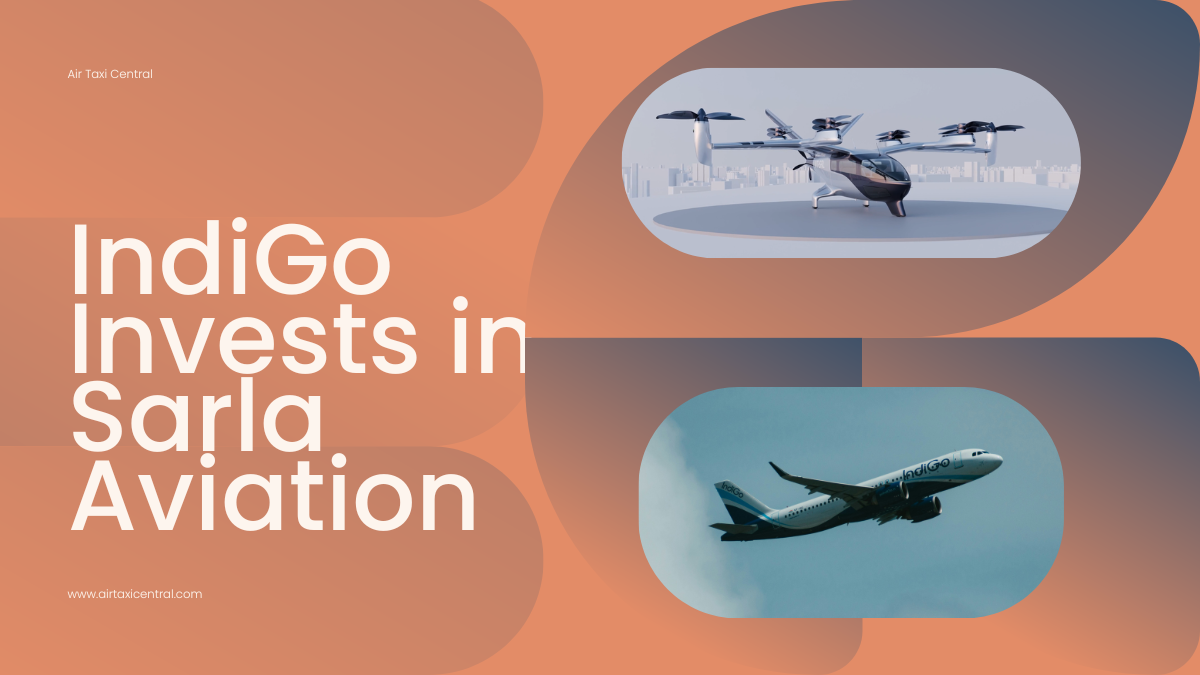
In India the biggest airline has just confirmed officially about a huge investment on the upcoming flying/air taxis. The company has officially announced that its venture capital arm, IndiGo Ventures, is investing in Sarla Aviation. Sarla Aviation is an Indian startup building electric vertical takeoff and landing aircraft (eVTOL).
This is not a small investment. This is a major strategic move. It says India is serious about becoming a player in the global flying taxi market.
IndiGo Ventures Announces Strategic Investment in Indian eVTOL Startup Sarla Aviation
Why This Matters (Three Key Things)
First thing: All we need to understand is IndiGo is not just an airline, its India’s leader in commercial aviation. If the company is all set to invest in eVTOL, it signals confidence that flying taxis are real.
Second thing: India is building its own eVTOL ecosystem. Instead of importing flying taxis from America or Europe, India is creating homegrown solutions. That’s strategically important.
Third thing: This investment will accelerate Sarla Aviation’s development – Money, Resources and Airline expertise.
India’s skies are about to get a lot quieter—and much more electric. IndiGo, the country’s dominant airline, is putting its massive weight behind Sarla Aviation, a homegrown startup building electric vertical takeoff and landing (eVTOL) aircraft.
This isn’t just a small side project; it’s a strategic move by a company that currently defines how India flies. Here is everything you need to know about the players involved and why this partnership is a big deal for the future of travel.
Who is IndiGo?
If you have flown within India, you’ve likely stepped onto an IndiGo plane. Based in Delhi and founded in 2006, IndiGo has grown into a global powerhouse over the last two decades.
- Market Leader: It is the largest airline in India by passenger volume.
- Massive Fleet: They operate over 300 aircraft and serve more than 75 domestic cities.
- Proven Success: With over 60 million passengers annually, they aren’t just a “budget airline”—they are a profitable, publicly traded giant that understands the Indian market better than anyone else.
Why their involvement matters: When a company of this scale invests in electric flight, it adds instant credibility. IndiGo brings nearly 20 years of experience in safety regulations, complex operations, and government relations that a startup simply doesn’t have yet.
Who is Sarla Aviation?
Sarla Aviation is a bold Indian startup aiming to solve one of the country’s biggest headaches: urban traffic. Instead of sitting in a car for two hours to cross Bengaluru or Mumbai, Sarla wants you to fly over it.
- The Mission: Developing fully electric aircraft that take off and land like a helicopter but fly like a plane.
- The Focus: Unlike some global competitors targeting luxury “private jet” crowds, Sarla is focusing on affordability and making urban air mobility accessible for regular commuters.
- India-First Design: Their aircraft are being built specifically to handle India’s unique weather conditions and infrastructure needs.

A Strategic Advantage
Sarla Aviation is currently in the development phase, meaning they are still refining their prototypes and haven’t started mass production. This is where IndiGo comes in.
By partnering with Sarla, IndiGo can provide more than just money. They offer a “masterclass” in how to run an aviation business. From navigating India’s strict aviation laws to preparing for commercial operations, IndiGo is the ultimate mentor.
Fact Check: While IndiGo was founded in 2006, it reaches the 20-year milestone in 2026. Regardless of the exact anniversary, they remain the most influential force in Indian aviation today.
Why they matter:
Most eVTOL companies are American or European. Companies like Joby, Archer, and Lilium are building for American and European markets.
Sarla Aviation is different and the company is building for India. It means:
- Aircraft designed for Indian weather
- Aircraft meeting Indian regulations
- Aircraft affordable for Indian market
- Aircraft optimized for Indian cities
This is important. India has unique needs. Indian weather is different. Indian regulations are different. Indian budgets are different.
The Investment: More Than Just a Check
While the exact financial details of the deal haven’t been fully disclosed, IndiGo Ventures has described this as a “significant” strategic investment. In the world of aviation startups, this likely puts the funding in the multi-million dollar range, providing Sarla Aviation with the runway they need to move from design to physical testing.
IndiGo’s reasons for jumping in now are clear:
- Strategic Positioning: Urban air mobility is no longer a “maybe.” IndiGo wants a front-row seat as the eVTOL market takes off.
- Homegrown Innovation: By backing Sarla, IndiGo is ensuring that India doesn’t have to rely on foreign tech. This is about building an Indian solution for Indian skies.
- Seamless Connections: Imagine landing at an airport and immediately hopping into an electric taxi to your office. The potential for “multi-modal” travel—where your airline ticket and air taxi are part of the same journey—is the ultimate goal.
Why India is the Perfect Proving Ground
India isn’t just another market; it is perhaps the best place on Earth for flying taxis to succeed. Our cities face unique challenges that traditional cars and trains simply can’t solve fast enough.
Several factors make India an eVTOL goldmine:
- Beating the Traffic: Cities like Delhi and Mumbai are famous for gridlock. Vertical takeoff removes the “road” from the equation entirely.
- Tech & Manufacturing: With a massive pool of engineering talent and a growing manufacturing sector, India has the “brain power” to build and maintain these complex machines locally.
- Government Support: Policy shifts are making it easier for drone and eVTOL startups to test and operate, showing that the regulatory wind is blowing in the right direction.
Major hubs like Bengaluru, Hyderabad, and Pune—cities with high-income tech populations and expanding borders—are expected to be the first to adopt these “sky commutes.”
When Can You Book a Flight?
We are closer than you might think. While global cities like Dubai are aiming for launches in late 2026, India’s timeline is following a realistic but ambitious path. Based on current development and testing phases, here is what the roadmap looks like:
- 2027–2028: Intensive testing and prototype flight trials across Indian cities.
- 2028–2029: Finalizing regulatory approvals with aviation authorities.
- 2029–2030: The first commercial routes are expected to go live in major metros.
Within the next three to four years, the sound of electric rotors over our cities could become a common reality. Thanks to the partnership between a giant like IndiGo and a pioneer like Sarla Aviation, India is well-positioned to lead the electric revolution in the air.
Indian eVTOL Companies Landscape
Sarla Aviation is not alone.
Other Indian eVTOL startups:
Sarla Aviation:
- Building passenger eVTOL
- Just got IndiGo investment
- Momentum accelerating
- Building emergency medical eVTOL
- Focus on healthcare transport
- Partnership with hospitals
Other startups:
- Several others in stealth mode
- Many in early development
- Some partnering with foreign companies
Market Competition
This investment puts pressure on other eVTOL companies.
Global eVTOL leaders:
- Joby Aviation – American leader, $3.2B funding
- Archer Aviation – American, United partner, $2.6B funding
- Lilium – European leader, $1.4B funding
- Vertical Aerospace – British company, strong funding
- Volocopter – German leader, European focus
- EHang Holdings – Chinese, already flying passengers
Regulatory Path Forward
How will Sarla Aviation get approved in India?
India’s aviation regulator:
The Directorate General of Civil Aviation (DGCA) oversees aircraft certification in India.
Certification requirements:
Sarla Aviation will need to certify their aircraft as:
- As an aircraft – Meet airworthiness standards
- For the route/operation – Meet operational requirements
- With qualified crew – Pilot licensing and training
This is similar to how FAA certification works in the USA, but following Indian regulations.
Timeline for certification:
Based on global experience:
- Application to DGCA: 2027-2028
- Certification process: 1-2 years
- First commercial approval: 2029-2030
Vision for India’s Flying Taxi Future
IndiGo and Sarla Aviation’s vision:
What they’re probably envisioning:
By 2030:
- Sarla Aviation aircraft flying in Delhi, Mumbai, Bangalore
- IndiGo operating some routes (code-sharing or partnership)
- Thousands of people flying eVTOL monthly
- Multiple vertiports in major cities
- Established network of flying taxi routes
By 2035:
- Flying taxis commonplace in Indian cities
- 50,000+ people flying monthly
- Expansion to secondary cities
- International routes (India to neighboring countries)
- Cargo delivery via eVTOL
- Emergency medical transport network
By 2040:
- Flying taxis are normal transportation
- India a global leader in eVTOL technology
- Multiple Indian manufacturers
- Export of aircraft to other countries
- Sarla Aviation a major global player
My (Amit’s) prediction:
Sarla Aviation will succeed. The combination of IndiGo’s backing, India’s market need, and capable founders is powerful.
Timeline:
- 2029: First commercial flights (probably)
- 2030-2035: Rapid expansion across India
- 2035+: Sarla Aviation becomes established player
Bigger Picture: India’s Innovation Ecosystem
This investment is bigger than just eVTOL.
It signals something important about India: India is not just consuming technology anymore. India is creating technology.
Examples:
- Software/IT: Infosys, TCS, Wipro (global leaders)
- Smartphones: Indians using apps others created
- Now: eVTOL aircraft – India building it, not importing
What this means:
India’s innovation ecosystem is getting better – entrepreneurs,, capital and solutions are on great pace. IndiGo’s investment in Sarla Aviation shows Indian companies have confidence in home country startups.
This will inspire more innovation, startups and competition. Also the better products.
India is becoming a technology leader, not just a market.
What This Means for You
If you live in India:
Within 5 years, you might be flying a Sarla Aviation eVTOL from Delhi airport to your office. This investment brings that future closer.
If you invest in aviation:
Sarla Aviation is now a company to watch. Not just locally. Globally. Indian companies can compete with American and European manufacturers.
If you care about urban air mobility:
India’s market is 1.4 billion people. If flying taxis succeed in India, that’s massive. More scale. Lower costs. Faster adoption worldwide.
If you work in aviation:
Jobs coming. Sarla Aviation will need engineers, designers, technicians, pilots, maintainers. Career opportunities in India’s aviation future.
Conclusion
The dream of “flying taxis” in India is moving out of science fiction and into reality. With IndiGo’s operational muscle and Sarla Aviation’s electric tech, the goal of clean, quiet, and affordable city travel is closer than ever.
Questions About eVTOL and India?
Email us: contact@airtaxicentral.com or amit@airtaxicentral.com
Follow us:
- Twitter: @AirTaxiCentral
- Instagram: @airtaxicentral
- YouTube: @AirTaxiCentral