

How $850 Million in New Funding Changes Everything
Vertical Aerospace just did something remarkable: it gave itself a second chance at life.
In April 2026, the British flying taxi company announced $850 million in new funding. That’s not just money. That’s validation. That’s proof that investors still believe in Vertical. That’s the difference between a company that survives and a company that disappears.
Six months ago, Vertical was running low on budget. The path to FAA certification was longer than planned. The competition was getting faster, better funded, and more aggressive.
But then the funding arrived: $250 million from Yorkville Advisors, $500 million in credit facilities, and $50 million from Mudrick Capital. And with that money came something equally valuable: time. Time to finish development. Time to pursue certification. Time to prove that British engineering can win in the flying taxi race.
This is the story of Vertical Aerospace’s comeback. And honestly? It changes everything we thought we knew about the company’s chances.
The Recent Funding: New Twist
Vertical Aerospace’s April 2026 funding deal is the most important announcement in the company’s history. Here’s why it matters so much.
The Numbers Tell the Story
The funding breakdown reveals how serious investors are about Vertical’s future:
- $250 million from Yorkville Advisors – Long-term capital partner
- $500 million credit facility – Additional runway if needed
- $50 million from Mudrick Capital – Respected venture capitalist
- $160 million immediately available – Ready to spend
- $700 million for certification – Path to commercial operations
Total: $850 million. That’s real money. That’s game-changing money and the company is all set to showcase skills.
But here’s what’s even more important: the structure of the deal. This isn’t venture capital bid on a moonshot. This is structured capital with specific milestones. Yorkville is known for strategic, long-term investments in companies with real technology.
That suggests investors have looked under the hood and liked what they saw.
Why This Timing Matters
Six months ago, Vertical was in a precarious position. The company had raised $200 million total. That sounded like a lot until you compared it to competitors:
- Joby Aviation: $976 million
- Archer Aviation: $550 million
- Lilium: $350 million
- Volocopter: $250 million
- Vertical Aerospace: $200 million (before this round)
Vertical was the most underfunded company among the leaders. The company was burning cash at an aggressive rate. The timeline to certification was slipping.
Then came the $850 million announcement.
Now Vertical has $1.05 billion in total committed capital. That puts Vertical in the conversation with the real leaders. Not Joby Aviation or Archer Aviation level, but no longer the financially weakest player at the table.
Who Is Vertical Aerospace?
Vertical Aerospace is a British eVTOL startup founded in 2014. Yes, you read that correctly: 2014. The company has been working on flying taxis for over a decade.
Most eVTOL companies were founded after 2016. Vertical was already in development when most competitors didn’t exist. That means Vertical’s team has been thinking about eVTOL longer than almost anyone.
The Company’s Real Advantage: Rolls-Royce Partnership
Here’s what separates Vertical from other emerging companies: Rolls-Royce.
Rolls-Royce is one of the world’s most respected aerospace and defense companies. They’ve been building aircraft engines for over 100 years. They’ve supplied engines to Boeing, Airbus, and every major aerospace manufacturer on Earth.
And Rolls-Royce chose Vertical.
In 2021, Rolls-Royce signed a partnership with Vertical Aerospace to develop hybrid-electric propulsion systems. This wasn’t venture capital betting on a technology that might work. This was an aerospace giant saying: “Vertical’s approach is solid. We’re putting our reputation and resources behind it.”
That’s the kind of validation you can’t buy with money alone.
The VA-X4: Serious Engineering
Vertical’s flagship aircraft is the VA-X4. It’s designed to carry four passengers and a pilot. It’s designed for urban air mobility—short distances, city-to-city flights, airport commutes.
The specifications look competitive:
- Capacity: 5 people (4 passengers + 1 pilot)
- Range: 100 miles (160 km)
- Speed: 150 mph (240 km/h)
- Vertical takeoff: Full VTOL, no runway needed
- Power: Hybrid-electric (electric + combustion backup)
- Development: 10+ years of iteration

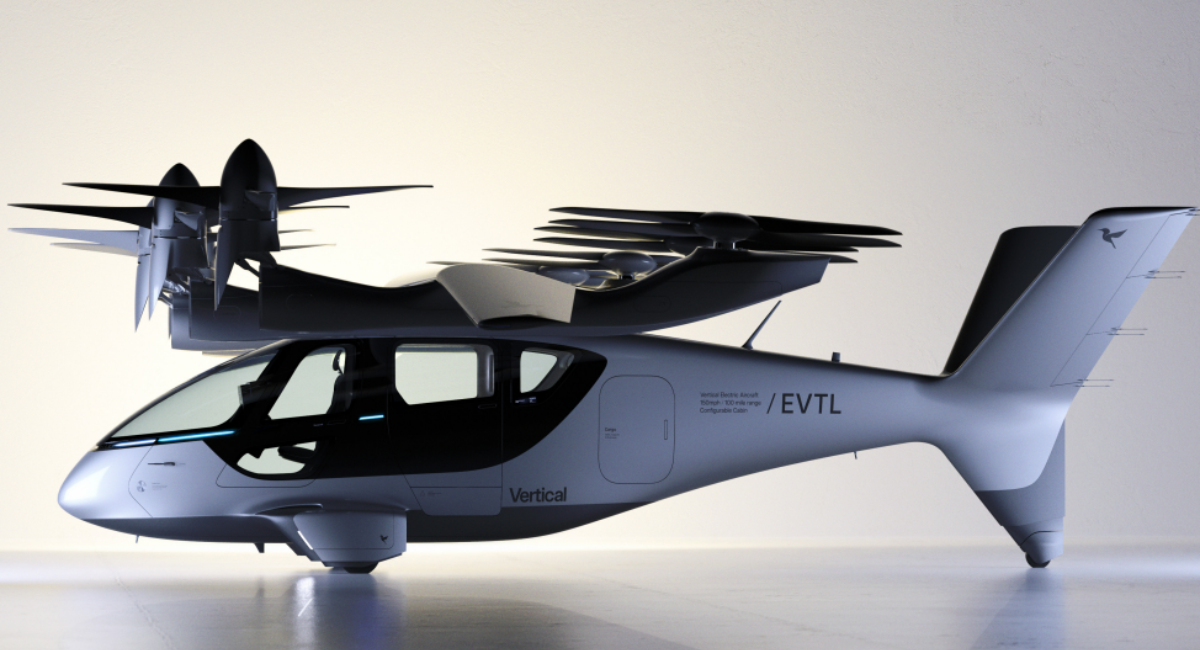
The VA-X4 is not a concept. It’s not a rendering. It’s an aircraft that’s been tested, refined, and improved for over a decade.
The Funding Lifeline: $850 Million Explained
Vertical’s April 2026 funding deal is structured differently than typical venture capital. Understanding the structure reveals why this funding is so valuable.
Yorkville Advisors: The $250 Million Anchor
Yorkville Advisors is not a traditional venture capital firm. Yorkville is a strategic investment company that focuses on long-term, structured deals with companies that have proven technology.
The $250 million commitment from Yorkville means:
- Deep investor confidence – Not betting on a concept, betting on proven technology
- Long-term partnership – Yorkville wants to be with Vertical for years, not months
- Significant capital – $250 million is enough to complete major development phases
- Reputation backing – Yorkville has invested in other aerospace and aviation companies
This isn’t just money. It’s validation from a respected institutional investor.
$500 Million Credit Facility: The Safety Net
In addition to $250 million in direct investment, Yorkville also provided a $500 million credit facility. This is important.
A credit facility is like a credit card. Vertical doesn’t have to use all $500 million immediately. But if the company needs it—for faster development, for unexpected costs, for hiring more engineers—the money is there.
This is more sophisticated than venture capital. This is institutional capital structure.
$50 Million from Mudrick Capital
Mudrick Capital is one of the most respected venture investors in the aerospace and automotive sectors. Mudrick has invested in companies like Arrival and Fisker. Mudrick understands the capital needs and timelines for hardware companies.
The $50 million from Mudrick signals that serious aerospace investors are bullish on Vertical.
$160 Million Available Immediately
Here’s the critical detail: $160 million of this funding is available to Vertical immediately. Not next quarter. Not next year. Now.
That means Vertical can:
- Accelerate VA-X4 development
- Hire more engineers
- Complete more testing phases
- Move faster through certification
- Build manufacturing partnerships
In the eVTOL race, speed matters. Having $160 million available to spend immediately gives Vertical momentum.
The Timeline: When Does Vertical Launch?
Vertical’s timeline is critical to understanding the company’s position in the broader eVTOL market.
Certification Timeline
Vertical is pursuing FAA certification in the United States. The company is targeting:
- 2028: FAA Type Certification approval
- 2028-2029: Begin commercial operations
- 2029+: Scale and expand operations
Is this timeline realistic? Yes. Here’s why:
- 10+ years of development – Vertical has been working on this since 2014
- Rolls-Royce partnership – Aerospace expertise built into the design
- Serious funding – $1.05 billion is enough to move fast
- Clear regulatory path – FAA has guidelines for eVTOL certification
Vertical won’t launch before Joby (2026 Dubai) or Archer (2027 U.S.). But 2028-2029 is realistic and achievable.
How This Compares to Competitors
Let’s be honest about the competitive timeline:
| Company | Launch Target | Status |
|---|---|---|
| EHang | Operating NOW | Already flying |
| Joby | 2026 Dubai | On track |
| Archer | 2027 U.S. | On track |
| Lilium | 2027-28 Europe | On track |
| Volocopter | 2028+ | Underfunded, slipping |
| Vertical | 2028-29 U.S. | NOW ON TRACK |
Vertical is no longer the “last company to launch.” With $1.05 billion in committed capital, Vertical is in a realistic race with Lilium and Volocopter for third place.
That’s a massive improvement from six months ago.
The Competitive Position: Where Vertical Stands Now
With $850 million in new funding, Vertical’s position in the eVTOL market has fundamentally changed.
Vertical’s Strengths
- British engineering heritage – Operating in Europe with potential U.S. expansion
- Rolls-Royce partnership – Aerospace expertise that competitors don’t have
- Proven technology – 10+ years of development, not a new concept
- Adequate funding – $1.05 billion is enough to compete seriously
- Clear regulatory path – FAA certification is achievable
Vertical’s Challenges
- Later timeline – Won’t launch until 2028-29, behind leaders
- U.S. focus without airline partner – Unlike Archer (United), Vertical has no airline backing
- Smaller addressable market initially – Limited to 100-mile routes
- Manufacturing scale – Will need to build aircraft at scale to compete
The Realistic Assessment
Here’s the honest truth: Vertical Aerospace is no longer the highest-risk eVTOL company. With $1.05 billion in committed capital and $160 million immediately available, Vertical has moved into the “real competitor” category.
Vertical won’t dominate the market. Joby probably will in 2026-27. Archer will probably win the U.S. market with United Airlines backing.
But Vertical? Vertical can absolutely establish itself as a serious player in Europe and the U.S. by 2029.
The $850 million funding announcement changed that calculus.
Funding Comparison: How Vertical Measures Up
With $1.05 billion in committed capital, how does Vertical compare to other eVTOL leaders?
| Company | Total Funding | Runway | Status |
|---|---|---|---|
| Joby | $976M | Sufficient | Market Leader |
| Archer | $550M | Adequate | Strong #2 |
| Lilium | $350M | Tight | Underfunded |
| EHang | $400M+ | Operating | Profitable |
| Volocopter | $250M | Critical | Struggling |
| Vertical | $1.05B | STRONG | Back in Game |
The April 2026 funding announcement put Vertical in a fundamentally different position. Vertical now has more committed capital than Lilium, Volocopter, and EHang.
That matters.
Why The Funding Matters For Vertical’s Future
The $850 million announcement isn’t just about numbers. It’s about momentum.
What This Funding Enables
- Accelerated certification – More engineers, faster progress
- Manufacturing partnerships – Money to build production relationships
- Talent attraction – Ability to hire top aerospace engineers
- Market confidence – Investors backing the company signals the product is real
- Geographic expansion – Resources to pursue both U.S. and European markets
What Changes In The Market
Before April 2026: Vertical was a company running on fumes, hoping to survive until certification.
After April 2026: Vertical is a well-funded company with a clear path to commercial operations.
That changes everything about how the market perceives the company.
Is Vertical A Good Investment?
With $1.05 billion in funding and a clear path to 2028-29 launch, is Vertical Aerospace a good investment?
Here’s the honest assessment:
The upside is real. If Vertical launches the VA-X4 on schedule in 2028-29, the company could capture significant market share in the 100-mile route market. That’s valuable.
The risk is also real. Certification could slip. Manufacturing could face challenges. Competition could intensify. The market might develop differently than expected.
But here’s what’s changed: Vertical is no longer a company betting its survival on finding funding. Vertical is a company with $160 million available to spend immediately and a clear path to commercial operations.
That’s fundamentally different.
My Opinion: Amit’s Analysis
I have watched Vertical Aerospace for two years, and I’ll be honest: I have been shocked. The company was underfunded. The timeline was slipping. The competitive position was deteriorating. I wrote Vertical off as likely to be acquired or merged out of existence.
Then came the April 2026 funding announcement. And I had to reconsider.
Here’s what the $850 million means: I was wrong about Vertical’s timeline, but I wasn’t necessarily wrong about the company’s market position.
Let me be clear: this funding doesn’t make Vertical the favorite. Joby is still the market leader. Archer still has United Airlines backing. Lilium still has European momentum.
But Vertical? Vertical is no longer the underfunded longshot. Vertical is a legitimate player with real capital, proven technology, and a clear path to commercial operations.
Will Vertical become a market leader? Probably not. Vertical will probably establish itself as a solid #3 or #4 player in the eVTOL market. That’s a $10-20 billion company. That’s not failure. That’s success.
The real question is whether Vertical can execute on its timeline and funding. If the company hits its milestones—certification by 2028, launch by 2029—then Vertical becomes a serious player.
If the company slips or encounters unexpected challenges, then the funding just extends the runway before a potential acquisition.
Either way, Vertical Aerospace is not the company I thought it was six months ago. The April 2026 funding changed that. I’m watching Vertical more carefully now. And I’m giving the company much better odds than before.
Conclusion
Vertical Aerospace just proved something important: the company is not dead. The company is alive and well-funded.
With $850 million in new funding, Vertical has:
- $160 million immediately available
- Clear path to FAA certification (2028)
- Realistic launch timeline (2028-29)
- Proven technology (10+ years development)
- Aerospace partner (Rolls-Royce)
- Competitive market position
Vertical won’t dominate the eVTOL market. But Vertical will probably be a significant player.
In a $94 billion market, that’s valuable.
Quick Links & Contact
Want to learn more about Vertical Aerospace?
- Official Website: verticalaerospace.com
- LinkedIn: Vertical Aerospace
- Funding Announcement: verticalaerospace.com/press
Want to compare Vertical to other eVTOL companies?
Read our full coverage:
- Joby Aviation: The Flying Taxi Company Backed by Toyota
- Archer Aviation: United Airlines Flying Taxi Partner
- Lilium: The Jet-Powered eVTOL Company Taking Over Europe
- EHang Holdings: The Company Already Flying Passengers
- Volocopter: German Engineering Meets eVTOL Technology
Have questions about eVTOL or flying taxis?
Contact us at: contact@airtaxicentral.com
Direct message Amit: amit@airtaxicentral.com
Air Taxi Central | Covering the eVTOL Revolution
airtaxicentral.com | @AirTaxiCentral