

In this article we will check the Real Numbers: Pilot Salaries, Battery Costs, and Everything relevant to eVTOL. First, let me explain you something important: flying taxis will only work if the companies can make money.
Right now, starting a flying taxi business is like building an airline from scratch. You need expensive planes, special places to land (vertiports), and lots of people to run everything. Because it’s all new, the first few years will be the most expensive.
Nobody knows if the money works out. This article explains the real costs. Just simple numbers: what does it cost Joby or Archer to fly one aircraft every single day?
eVTOL Operating Costs: How Much Does It Cost To Run a Flying Taxi Business?
Three Key Things To Know Before Reading
First thing: Flying taxi companies have TWO types of costs.
One cost is per flight (pilot, battery, landing fee). The other cost happens no matter what (building vertiports, buying aircraft, hiring workers).
Both costs matter.
Second thing: The price you pay ($100-300 per ride) must cover BOTH types of costs.
If it doesn’t, the company loses money. And if the company loses money long enough, it goes out of business.
Third thing: This is why price matters so much.
Flying taxi needs to be cheap enough that people use it. But also expensive enough that the company makes profit. It’s a balance.
Now let me break down the actual numbers.
Important Note
These numbers are estimates based on:
- What companies have said publicly
- Industry reports
- Similar businesses (helicopters, Uber)
- Expert analysis
The real costs might be different. But these numbers are close.
Cost Per Flight (The Simple Costs)
First, let’s understand what it costs to fly one aircraft one time.
Pilot salary cost (shared across many flights): $15-30
Battery power (electricity to charge): $15-25
Maintenance (wear and tear): $10-20
Landing fee (at vertiport): $5-15
Ground crew (handling aircraft): $5-10
Other costs (insurance, repairs, etc): $10-15
Total cost per one flight: $60-115
This is basic. Just what you need to actually fly.
But remember: this assumes 4-6 passengers on each flight.
If the flight is half empty (2-3 passengers), the cost per passenger goes up.
Cost To Buy Aircraft (Amortized)
This is the big one that people forget. Flying taxi aircraft cost $2-4 million per aircraft. Let’s say $3 million. A company buys 10 aircraft. That’s $30 million just sitting there waiting to make money.
How long will these aircraft last?
Maybe 15-20 years if they’re maintained well.
Let’s say 15 years = 180 months.
If each aircraft does 10 flights per day:
- 10 flights × 30 days = 300 flights per month
- 300 flights × 180 months = 54,000 flights over 15 years
Cost per flight to pay for aircraft:
$3 million ÷ 54,000 flights = $55 per flight
This cost gets added to every single flight. Forever.
So far we’re at: $115 (operational) + $55 (aircraft) = $170 per flight
Vertiport Costs
Flying taxis need places to land and take off. A vertiport (landing pad + building) costs $3-10 million to build.
Let’s say $5 million for a decent one. Some cities might have 10 vertiports. That’s $50 million just in buildings.
How many flights per month across all vertiports?
If each vertiport handles 10 flights per hour during operating hours (say 16 hours per day):
- 10 flights × 16 hours = 160 flights per day
- 160 flights × 30 days = 4,800 flights per month
Cost per flight to pay for vertiports:
$50 million ÷ (4,800 flights per month × 180 months) = $58 per flight
So far we’re at: $170 + $58 = $228 per flight
People & Infrastructure Costs
Companies need workers beyond just pilots.
Maintenance workers: Fix aircraft, inspect, repair
Operations staff: Scheduling, customer service, tech support
Marketing: Tell people about flying taxis
Office staff: Accounting, HR, management
Technology: Software systems, safety monitoring, apps
Insurance: Liability insurance, aircraft insurance
For one city with 10 aircraft and maybe 100-200 flights per day:
Maybe 50-100 employees total.
Average salary (mix of high and low): $60,000 per year
100 employees × $60,000 = $6 million per year
Plus benefits, office, technology = maybe $8-10 million per year
How many flights per year?
100 flights per day × 365 days = 36,500 flights per year
Cost per flight:
$10 million ÷ 36,500 flights = $274 per flight
So far we’re at: $228 + $274 = $502 per flight
Total Operating Cost (Simple Version)
Let me add it all up:
- Per-flight operational: $115
- Aircraft cost amortized: $55
- Vertiport cost amortized: $58
- People and infrastructure: $274
Total: $502 per flight
But wait. This assumes:
- Every flight has 5 passengers
- Aircraft are filled 80% of the time
- Everything runs perfectly
- No unexpected problems
What If Flights Aren’t Full?
This is the real problem. If a flight should have 5 passengers but only has 3:
- The cost per passenger goes up. Also, if vertiports are busy, they’ll charge more landing fees. If aircraft break down, maintenance costs go up.
Realistic total cost per flight: $500-700 (depending on occupancy)

Cost Per Passenger
If one flight costs $600 and has 5 passengers:
$600 ÷ 5 = $120 per passenger
This is the company’s cost.
The company needs to charge MORE than this to make profit. That’s why the ticket price needs to be $150-300 (depending on distance). $150-300 ticket price covers $120 cost + company profit.
Monthly Cost Breakdown (One City, One Company)
Let’s say Joby operates in Los Angeles with:
- 10 aircraft
- 3 vertiports
- 100 flights per day on average
- 5 passengers per flight average
Monthly costs:
Aircraft purchase (amortized): 10 × $3M ÷ 180 months = $167,000
Vertiport costs: $50M ÷ 180 months = $278,000
Pilot salaries: 30 pilots × $5,000/month = $150,000
Battery/electricity: 3,000 flights × $20 = $60,000
Maintenance: 3,000 flights × $15 = $45,000
Staff & operations: $800,000
Marketing: $200,000
Insurance: $400,000
Technology & software: $150,000
Misc. costs: $150,000
Total monthly: $2.4 million
Flights per month: 3,000
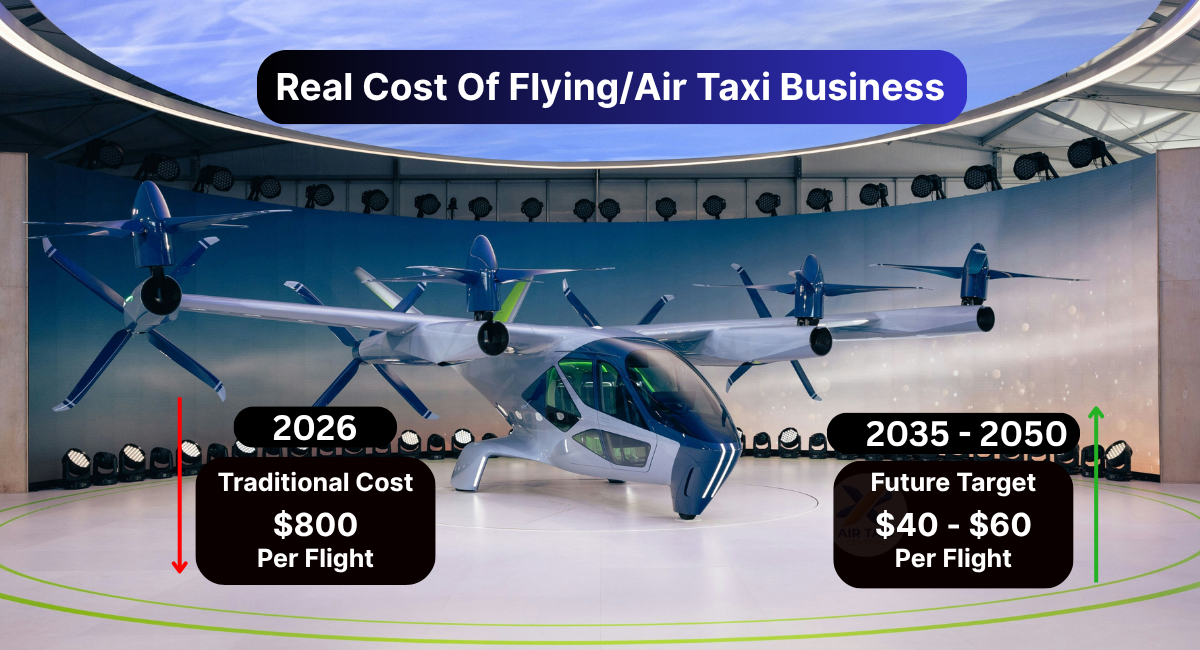
Cost per flight: $800
Wait. That’s higher than my earlier estimate. Why?
Because I’m being more realistic about all the hidden costs.
How Much Must The Company Charge?
To break even (no profit, no loss):
$800 cost per flight ÷ 5 passengers = $160 per passenger minimum
To make profit (30% profit margin):
$160 × 1.30 = $208 per passenger
So minimum price to break even: $160
Price to make real profit: $200-250
This is why initial prices will be $150-300.
How Many Flights Needed To Break Even?
Let’s say Joby invests $500 million total to start operations across multiple cities.
$500 million ÷ $600 cost per flight = 833,000 flights needed to break even
How long does that take?
If Joby does 100 flights per day across all cities:
833,000 flights ÷ 100 per day = 8,330 days = 23 years to break even
That’s a long time!
But wait. This assumes Joby makes ZERO profit per flight. Just breaks even.
In reality:
If Joby charges $200 per flight and cost is $600:
Joby loses $400 per flight for many years.
Joby keeps losing money until:
- Flight costs go down (batteries cheaper, aircraft cheaper)
- More flights happen (more people using it)
- Prices go up (people willing to pay more)
Timeline to profitability: probably 5-10 years if things go well
What Affects Operating Costs
Several things change the actual costs:
Battery Cost
If batteries get cheaper (they will), cost per flight goes down.
- Currently: $20-25 per flight
- By 2030: maybe $12-15 per flight
- By 2040: maybe $5-8 per flight
Aircraft Cost
As more aircraft are built, price per aircraft drops.
- Currently: $2-4 million each
- By 2030: maybe $1.5-2 million
- By 2040: maybe $800,000-1 million
Labor Costs
- If demand is high, pilot salaries go up.
- If demand is low, salaries go down.
- Also, eventually autonomous flight might reduce pilot costs.
Volume
More flights = costs spread across more flights.
100 flights per day is cheaper per flight than 10 flights per day.
Maintenance
Electric aircraft should be cheaper to maintain than helicopters.
Timeline: When Do Costs Drop?
2026-2027: High costs. Maybe $600-800 per flight.
2028-2030: Costs dropping slowly. Maybe $500-600 per flight.
2030-2035: Costs dropping faster. Maybe $300-400 per flight (batteries cheaper, aircraft cheaper, more flights).
2035-2040: Costs dropping significantly. Maybe $150-250 per flight.
Break-Even Analysis
A company needs to reach a point where income = expenses.
Income: Price per flight × Number of flights
Expenses: All the costs we listed above
Break even: When Income = Expenses
Example:
If costs = $600 per flight and price = $200 per flight:
$200 × 3 passengers = $600 income (break even!)
Wait, that only works if flights have 3 passengers AND the price is $200.
What if flights have 5 passengers AND price is $200?
$200 × 5 passengers = $1,000 income
$1,000 income – $600 cost = $400 profit per flight
That’s good!
What if flights have 2 passengers AND price is $200?
$200 × 2 passengers = $400 income
$400 income – $600 cost = -$200 loss per flight
That’s bad. The company loses money.
So the key is: Enough passengers + high enough price = profit
Amit Opinion: Will Companies Make Money?
Year 1-2 (2026-2027): No. Companies lose money.
Costs are high. Prices are high. Not enough customers yet.
Year 3-5 (2028-2030): Still losing money. But less.
Costs dropping. More customers. But still not profitable.
Year 5-10 (2030-2035): Some break even. Some make profit.
By 2035, Joby and Archer probably make small profit.
Year 10+ (2035+): Profitable. Growing.
Once profitable, costs continue dropping. Profits grow.
The question: Can companies survive the losing years?
If investors have money to lose for 5-10 years, yes.
Joby has $3+ billion in funding. That’s enough to lose money for many years. Most companies won’t survive. Only the best funded ones (Joby, Archer, Lilium) have shot.
Common Questions & Answers
Question 1: Why is it so expensive right now?
Answer: Everything is new and pricey. The flying taxis themselves cost a lot to build, and we have to build “vertiports” (landing pads) for them. Since there aren’t many flights yet, these big bills have to be paid by a small number of passengers.
Q: When will it cost the same as an Uber car?
Answer: Not for a long time—likely between 2040 and 2050. For a flight to cost you $40–$60 (like a long Uber ride), the company’s cost needs to drop significantly. We are at least 15 years away from that.
Q: Are the batteries the main reason it’s expensive?
Answer: Actually, no. The biggest cost is people. Paying pilots and ground staff costs the most money. After that, the next biggest costs are the buildings and the aircraft themselves.
Q: How can companies make it cheaper?
Answer: There are four main ways:
- Self-flying tech: Removing the pilot saves a lot of money.
- Cheaper batteries: Better technology will lower power costs.
- Mass production: Making more planes makes each one cheaper.
- More flying: The more trips a plane makes in a day, the less each seat costs.
Q: Will every flying taxi company succeed?
Answer: No. Many startups will likely go out of business. Only the companies with the most money and the smartest management will survive this “startup” phase.
Q: How many trips does a company need to make to stay alive?
Answer: A company usually needs to fly 50 to 100 trips every day in a single city. If they fly less than that, they won’t make enough money to pay for their buildings and staff.
Learn More About eVTOL Economics
Read our other articles:
- How Much Will eVTOL Cost? – What passengers pay
- Investing in eVTOL – Stock information
- Battery Technology – Why batteries affect costs
Questions About eVTOL Operating Costs?
Email us: contact@airtaxicentral.com or amit@airtaxicentral.com
Follow us:
- Twitter: @AirTaxiCentral
- Instagram: @airtaxicentral
- YouTube: @AirTaxiCentral