

In this article, I will inform you about Indian companies building flying taxis. So, the global market has Joby, Archer, and Lilium. But India has its own companies. Indian startups are building aircraft, engineers are designing autonomous systems and the Indian companies are competing to dominate India’s market.
Most people think flying taxis are only built in Silicon Valley or Germany or Europe. But India is building them too. And some Indian companies might win the race to dominate Asia.
Let me introduce you to India’s flying taxi companies.
The Complete Guide To India’s Aerospace Startups Racing To Dominate Flying Taxis
Why Indian Companies Matter
India is not a follower in aviation, the country is building aerospace companies. As per the current stats, India has 1.4 billion people and has massive cities with huge traffic. India has talented engineers and designers which leads to manufacturing capability.
So why shouldn’t India have leading eVTOL companies?
The answer: India should. And India does.
But these companies are quiet. They don’t raise billions in venture capital. They don’t get headlines in press/media in starting. The companies working quietly, building technology and proving concepts.
The Indian eVTOL Ecosystem
India has multiple companies working on flying taxis and urban air mobility.
- Some are building aircraft directly.
- Some are building drones that could become flying taxis.
- Some are building components and systems.
- Some are service providers.
All of them matter.
Let me explain each one.
1: AUTOSYNC AVIATION – India’s primary eVTOL company
What Autosync does:
Autosync Aviation is India’s primary eVTOL company building electric aircraft for urban air mobility. Autosync is designing autonomous systems and wants to compete with Joby and Archer.
Autosync is the closest thing India has to a global eVTOL contender.
The Autosync Aircraft:
Aircraft name: AutoSynC-300
Passengers: 2-4 people
Range: 30-50 miles
Speed: 100+ mph
Status: In development
Timeline: Commercial operations 2027-2028
Autosync’s Advantage:
Autosync started early. Founded in 2018, Autosync has been developing aircraft for 6+ years and I think that’s time to learn, iterate and get things correct.
Autosync has Indian government support and backed with a proper plan. The Indian government wants domestic aerospace companies.
Autosync has engineering talent. Bangalore is India’s tech hub. Autosync has hired talented engineers from India’s tech companies.
Autosync’s Challenges:
Autosync has less funding than global competitors. Joby raised $976 million. Autosync raised less. Much less.
Autosync has no major corporate backing. Joby has Toyota. Archer has Stellantis. Autosync has Indian venture investors. That’s good. But not the same as a $50 billion automaker.
Autosync is racing against better-funded companies. Joby will launch in Dubai in 2026. Autosync targets 2027-2028. That’s 1-2 years behind.
My Prediction on Autosync:
Autosync could win India but might not win globally. But the company could dominate India’s market if it launches first.
2: IDEAFORGE TECHNOLOGY – The Drone Giant
What IdeaForge does:
IdeaForge makes drones. Not simple drones. Advanced, professional drones. IdeaForge’s drones are used by governments, enterprises, and militaries. The company has real customers, real revenue and real experience.
IdeaForge’s Background:
Founded: 2007 (long history in aerospace)
Funding: $50+ million (most funded Indian aerospace company)
Employees: 300+ people
Products: Professional UAVs and drones
Customers: Government, enterprise, defense
Why IdeaForge Could Enter eVTOL:
IdeaForge already builds autonomous aircraft. Drones are autonomous. The technology transfers to eVTOL. The company has manufacturing expertise, knows how to design aircraft, knows how to manufacture them and has supply chains.
IdeaForge has capital. $50 million is real money and its sound interesting. IdeaForge could invest in eVTOL development.
The company has credibility and when it get ready to enter in a market, people will notice. Government will notice.
Has IdeaForge Announced eVTOL Plans?
Not yet. IdeaForge is still focused on drones. Chinese drone company DJI shifted gear into other robotics. IdeaForge could do the same.
IdeaForge’s Potential:
If IdeaForge enters eVTOL, it will become a serious global player.
But IdeaForge hasn’t announced eVTOL plans yet.
3: SARLA AVIATION – The Cargo Drone Leader
What Sarla does:
Sarla Aviation is a Bengaluru-based aerospace startup, founded in 2023, that develops electric vertical take-off and landing (eVTOL) aircraft to launch affordable, safe, and sustainable flying taxi services in India by 2028.
They aim to revolutionize urban transit, reduce traffic congestion, and plan to launch in cities like Bengaluru, Mumbai, and Delhi.
But Sarla’s technology could support eVTOL.
Sarla’s Focus:
- Cargo drones for delivery
- Autonomous flight systems
- Logistics and transport solutions
- Heavy-lift unmanned aircraft
Why Sarla Matters:
Sarla is building autonomous systems. That’s critical for eVTOL.
Sarla’s Status:
Sarla is active and is growing. Sarla has real products in development.
Meanwhile, Sarla unveiled its prototype air taxi at the January Bharat Mobility Global Expo. The eVTOL is designed to carry up to six passengers on 20–30 km trips with speeds reaching 250 kmph.

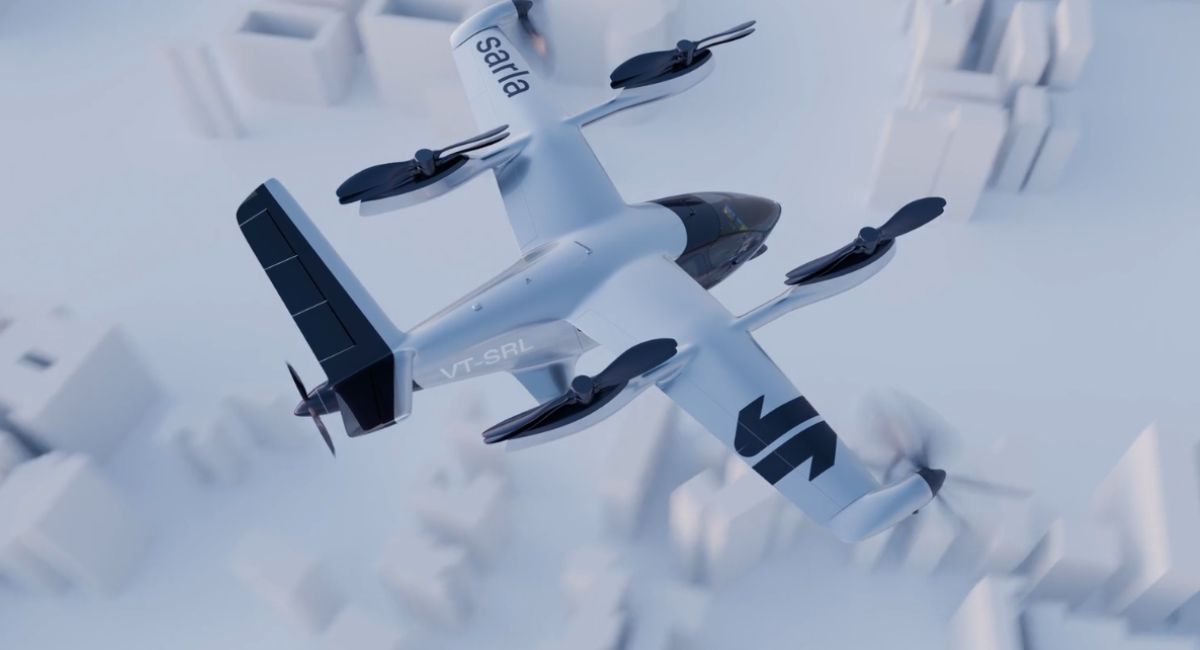
Also, Sarla signed a partnership with Bengaluru International Airport to launch its air taxis at Kempegowda International Airport. The proposed route from the airport to Bengaluru’s Electronics City would take approximately 19 minutes, compared to the 152 minutes required by road.
4: AARAV UNMANNED SYSTEMS – The Autonomous Specialist
What Aarav does:
Aarav builds autonomous unmanned aircraft systems, focuses on delivery drones and autonomous platforms. Foe now . it is expanding across India and Southeast Asia.
Aarav’s Focus:
- Autonomous flight control systems
- Delivery drones
- Commercial applications
- Southeast Asia expansion
Aarav’s Position:
Aarav is younger than IdeaForge or Sarla. But the company is growing fast and focusing on autonomous technology. That’s the future. Autonomous is where the industry is going.
Aarav’s Potential:
Aarav could develop eVTOL technology as it’s autonomous expertise is valuable. In future, the company could partner with other companies or develop independently.
But Aarav hasn’t announced eVTOL plans yet.
5: SEABIRD TECHNOLOGIES – The Materials Supplier
What Seabird does:
Seabird makes advanced materials and composites for aerospace. Seabird is a B2B supplier. Seabird supplies components and materials.
Seabird’s Role:
Seabird is not a direct competitor, it is part of the supply chain. When Autosync builds aircraft, Seabird could supply materials. When IdeaForge builds eVTOL, Seabird could supply components.
Why Seabird Matters:
Supply chain is critical. You can’t build aircraft without materials. It is building materials that Indian aircraft manufacturers need.
6: THROTTLE AEROSPACE SYSTEMS – The Propulsion Company
What Throttle does:
Throttle Aerospace builds advanced propulsion systems and focuses on rocket and aerospace propulsion.
But Throttle’s technology could apply to eVTOL.
Throttle’s Unique Angle:
- Electric propulsion research
- Advanced motor systems
- Aerospace propulsion expertise
Why Throttle Could Matter:
eVTOL needs electric propulsion. Throttle is researching electric propulsion and could become a critical supplier. As you now know, this company might develop eVTOL directly in the future.
The company is on early stage and we are waiting for eVTOL plan announcements.
7: HATZOLAH AIR – The Emergency Use Case
What Hatzolah does:
Hatzolah operates air ambulance services and transports emergency patients using aircraft. The company currently uses helicopters. But it could use eVTOL when available.
Hatzolah’s Importance:
Hatzolah proves use case. When eVTOL launches, Hatzolah could be an early customer.
Flying ambulances save lives. Faster transport is always win because that bring better outcomes. Hatzolah could be a model for emergency eVTOL use.
Why This Matters:
eVTOL companies need customers. Hatzolah could be a customer and could prove eVTOL works in real emergency scenarios.
8: ARPIT AEROSPACE – The Manufacturing Backbone
What Arpit does:
Arpit Aerospace manufactures aerospace components and parts. Arpit is a supplier, not a manufacturer of complete aircraft. But it is building the manufacturing capability that India needs.
Arpit’s Role:
Component manufacturing
Aerospace parts supply
Manufacturing expertise
Supply chain development
Why Arpit Matters:
India needs manufacturing. When Autosync scales production, Arpit could supply components. When other companies grow, it supports them.
Arpit is infrastructure. Infrastructure wins long-term races.
9: AKFLY – The Service Operator
What Akfly does:
Akfly operates aviation services. Akfly is an operator, not a manufacturer.
But when eVTOL launches, Akfly could operate services.
Akfly’s Potential:
Operating eVTOL services
Air taxi operations
Commercial air transportation
Why Akfly Matters:
Someone has to operate flying taxis. Akfly could be that someone.
Akfly has experience operating aircraft. Akfly understands the business. Akfly could transition to operating eVTOL.
10: DHRUV AEROSPACE – The New Generation
What Dhruv does:
Dhruv Aerospace is a startup and it focuses on aerospace engineering and technology development.
Dhruv is early stage. But the company represents the next generation of Indian aerospace talent.
Dhruv’s Potential:
Dhruv could develop eVTOL components. It could partner with larger companies and could eventually build complete aircraft.
The Complete Indian Ecosystem
Here’s the important thing: India has companies at every level.
Aircraft manufacturers: Autosync (direct competitor to Joby)
Drone companies pivoting: IdeaForge, Sarla, Aarav (could become eVTOL)
Component suppliers: Seabird, Throttle Aerospace (supply chain)
Service operators: Akfly, Hatzolah (could operate eVTOL)
Manufacturing: Arpit Aerospace (manufacturing backbone)
New startups: Dhruv (future potential)
This is an ecosystem. One company doesn’t win. The ecosystem wins.
Comparison: Indian Companies vs Global Companies
Let me be honest about the comparison.
Autosync vs Joby:
Joby: $976 million funding, backed by Toyota, launching 2026-2027
Autosync: Undisclosed but significantly less, Indian backing, launching 2027-2028
Joby wins on funding and timeline.
Autosync vs Archer:
Archer: $550 million, backed by Stellantis, launching 2027
Autosync: Less funding, Indian backing, launching 2027-2028
Archer wins on funding and corporate backing.
IdeaForge vs Joby/Archer:
IdeaForge hasn’t announced eVTOL yet. If IdeaForge enters, IdeaForge could be competitive.
IdeaForge has $50 million. IdeaForge has 300+ employees. IdeaForge has manufacturing expertise.
But IdeaForge would be starting from scratch on eVTOL.
The Reality:
Global companies are ahead and have more funding. Global companies have more corporate backing.
But Indian companies have advantages too.
Indian Advantages:
Lower costs (manufacturing in India is cheaper)
Government support (India wants domestic companies)
Local understanding (India’s market, India’s cities, India’s needs)
Talent (Indian engineers are world-class)
Can Indian Companies Win?
Here’s my honest assessment.
Short term (2026-2030): Indian companies struggle. Global companies launch first as all the companies have more resources and are behind.
Medium term (2030-2035): Indian companies could compete. If Autosync executes well, it could capture India’s market. If IdeaForge enters, IdeaForge becomes serious player.
Long term (2035+): Indian companies could dominate because the main reason is manufacturing in India is cheaper. India’s market is huge.
Government Support: “Make in India”
India’s government wants domestic aerospace industry. The government supports “Make in India” initiative.
The government could:
- Support Indian eVTOL companies with funding
- Help with regulatory approval
- Provide vertiport development support
- Give tax incentives
- Purchase aircraft for government services (ambulances, transport)
This support could be game-changer. Indian companies could leapfrog development with government backing.
My Opinion: Amit’s Honest Review
I have studied Indian aerospace companies for this analysis. Here’s what I think.
Autosync could win India.
Autosync is focused and has government support. The company has talented engineers. If Autosync executes well, the company dominates India’s market.
But Autosync won’t beat Joby globally. Joby is too far ahead and has too much money.
IdeaForge could be the surprise.
IdeaForge has capital, expertise, and credibility. If IdeaForge decides to enter eVTOL, IdeaForge becomes serious competitor.
I would watch IdeaForge closely. IdeaForge could shock everyone.
Sarla and Aarav are potential.
Both have autonomous technology. Both could develop eVTOL and are early stage.
The supply chain matters.
Seabird, Throttle Aerospace, Arpit Aerospace – these companies are infrastructure. Infrastructure wins long-term.
India’s ecosystem is building. India could become manufacturing hub for global companies.
My prediction:
By 2030, Autosync will operate in India. Joby and Archer will operate globally and in major Indian cities.
By 2035, Indian companies could scale manufacturing and companies could export aircraft. And finally then India will become manufacturing hub.
By 2045, India could have world-class aerospace industry. Like India’s IT industry. Like India’s pharmaceutical industry.
Conclusion
India is building flying taxis. Indian companies are working on autonomous aircraft. Indian engineers are designing systems.
Will Indian companies beat Joby? Probably not globally.
Will Indian companies dominate India’s market? Maybe. Autosync has a chance.
Will India become manufacturing hub for global companies? Probably yes.
Want To Learn More?
Read our complete eVTOL guides:
- Joby Aviation: The Flying Taxi Company Backed by Toyota
- Archer Aviation: United Airlines Flying Taxi Partner
- Lilium: The Jet-Powered eVTOL Company
- Wisk Aero: Boeing’s Autonomous Flying Taxi
Also read our market analysis:
- Vertiports: The Hidden Infrastructure Challenge
- Joby vs Archer vs Lilium: Which Flying Taxi Company Will Actually Win?
Questions?
Contact Air Taxi Central at contact@airtaxicentral.com or reach Amit at amit@airtaxicentral.com.