


Connect with us

Guides

eVTOL Air Traffic Management: The Flying Car revolution has a massive traffic problem

How will air traffic control handle thousands of eVTOL? Complete guide to airspace management challenges, technology solutions (UTM, DAA, ADS-B), and timeline for safe eVTOL integration into existing airspace.

Published

on

eVTOL Air Traffic Management

We have all seen the official renders of electric vertical take-off and landing (eVTOL) craft whisking commuters over gridlocked highways. It’s a beautiful vision, but there’s a logistical elephant in the room that the industry is largely glossing over: the sky is actually getting pretty crowded.

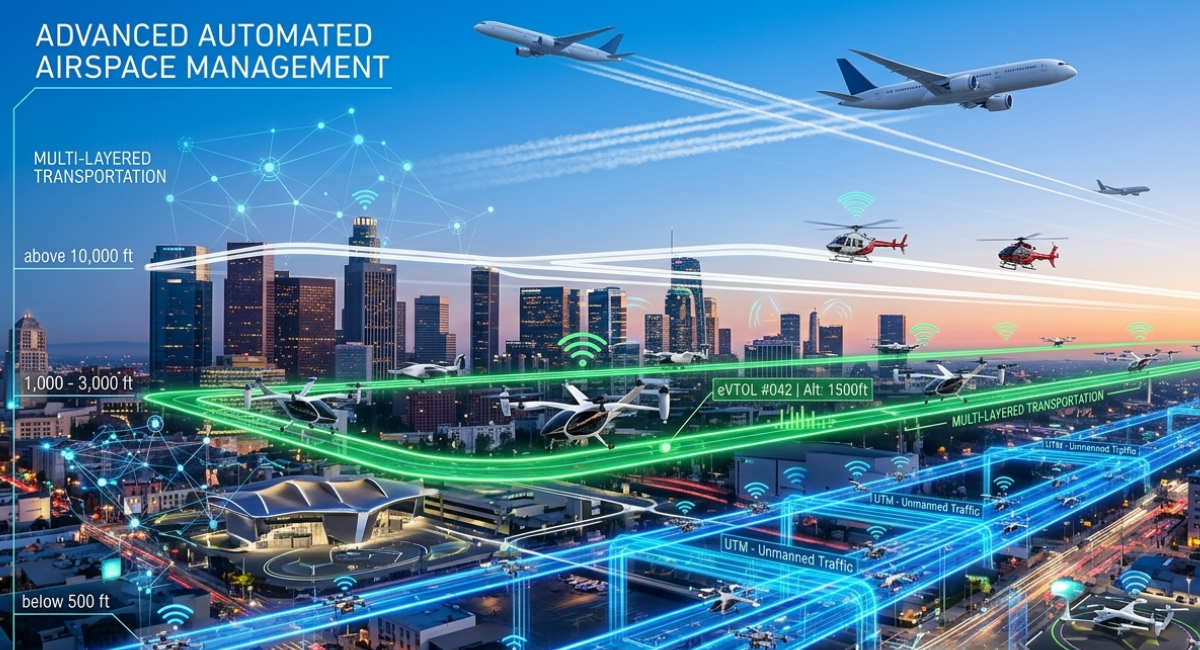
Right now, our airspace is a neatly organized layer cake. You’ve got commercial jets cruising at 30,000 feet, general aviation and helicopters hanging out in the 1,000 to 3,000-foot range, and hobbyist drones capped at 400 feet. It’s a system built on decades of rules and human controllers keeping things easy.

Adding thousands of flying taxis changes everything. These planes fly low, take off straight up, and there will be a lot of them in a small space. This isn’t just a few extra flights; it is a massive amount of traffic that would be too much for human air traffic controllers to handle. The biggest problem for flying cars isn’t just the batteries or the noise—it’s the computer systems.

We need to figure out how to build a smart, safe system that can manage thousands of vehicles at once without any crashes. Until we solve this traffic puzzle, these futuristic rides won’t be taking off.

The Challenge of Coordinating Flying Taxis, Helicopters, Drones, and Planes in the Same Sky

How do thousands of eVTOL aircraft share airspace with helicopters, drones, and planes without constant near-misses?This is the air traffic management problem. And it’s one of the biggest challenges eVTOL faces.

This guide explains how current air traffic works. Why eVTOL breaks the system. What technology solutions exist. And when we’ll have answers.

How Air Traffic Works Today

To understand the problem, we first need to look at how we manage the sky right now. It is actually a very organized system based on height.

The Basic Setup:

Think of the sky like a tall building with different floors (called “Classes”). Everyone has a floor where they are allowed to be:

  • The Top Floors: Big airplanes fly very high up, usually above 18,000 feet.
  • The Middle Floors: These are for planes near big or medium-sized airports.
  • The Bottom Floors: This is where small airports and private planes operate, usually closer to the ground.

How a Flight Happens:

  • The Plan: A pilot tells the “traffic police” (Air Traffic Control) where they want to go.
  • The Permission: The controller tells the pilot it is safe to take off.
  • The Path: The pilot stays at a specific height and follows a set path.
  • The Watching: Controllers watch their screens every second to make sure planes stay far apart.

Why It Works (For Now):

This system works because everyone follows the rules and stays on their own “floor.” Most importantly, there aren’t that many planes in the sky at once. A big airport might handle 50 to 100 planes in an hour. This gives human controllers plenty of time to make safe decisions.

The current system was built for this amount of traffic. It simply wasn’t made to handle thousands of new flying taxis all at once.
eVTOL Air Traffic Management

eVTOL Air Traffic Management (Image demo)

The Problem: eVTOL Changes Everything

Now flying taxis are getting ready.

eVTOL aircraft operate at:

  • 500-3,000 feet (low altitude)
  • Vertical takeoff and landing (unpredictable paths)
  • High frequency (many flights per hour)
  • Dense spacing (multiple aircraft per area)

The math:

If Los Angeles has 10 vertiports. Each vertiport handles 200 flights per day. That’s 2,000 flights per day in LA alone.

Current system: 100 flights per hour maximum per airport.

eVTOL potential: 400-600 flights per hour across the city.

That’s 4-6x current capacity. In much more complicated airspace.

Why this breaks current system:

  1. Altitude overlap: eVTOL shares altitude with helicopters
  2. Density: Much more aircraft in same area
  3. Complexity: Vertical takeoff/landing needs special handling
  4. Coordination: Thousands of aircraft need real-time coordination
  5. Automation: Current system is manual. Can’t scale manually.

You can’t have a human air traffic controller managing 500 eVTOL aircraft. They’d lose track in seconds.

Integration Challenges Explained

Let’s understand the specific challenges:

Challenge  number 1: Density

Too many aircraft. Not enough airspace.

Current system: Handles maybe 100 aircraft per hour in an area.

eVTOL future: Needs to handle 500+ aircraft per hour.

Solution: Need new system that handles density.

Challenge number 2: Altitude Conflict

eVTOL flies at same altitude as helicopters.

If helicopter is flying at 1,500 feet. eVTOL wants to fly at 1,500 feet. They can’t both be there.

Solution: Need clear separation or sophisticated deconfliction.

Challenge number 3: Unpredictable Paths

Airplanes have predictable routes. They follow airways.

eVTOL takes off vertically from anywhere. Lands vertically anywhere. Less predictable.

Solution: Need system that can handle dynamic paths.

Challenge number 4: Real-Time Coordination

Current system has humans making decisions. This works for 100 aircraft.

500+ aircraft? Humans can’t keep up.

Solution: Need automation. Computers need to coordinate.

Challenge number 5: Safety Redundancy

Current system has backup. If one controller loses track, another catches it. With thousands of eVTOL? Need multiple backup systems.

Solution: Need technology that ensures safety even with failures.

Challenge number 6: Integration with Existing System

eVTOL can’t operate separately. Must integrate with:

  • Air traffic control
  • Helicopter operations
  • Drone regulations
  • Airplane routes

Solution: Need system that bridges all aircraft types.

Technology Solutions: What’s Being Developed

Several technology approaches are being developed:

Solution number 1: UTM (Unmanned Traffic Management)

UTM is technology for managing drones.

What it does:

  • Tracks all aircraft in real-time
  • Detects conflicts automatically
  • Suggests route changes
  • Manages traffic flow

How it works:

  • Every aircraft broadcasts position
  • Central system tracks all positions
  • Algorithm calculates safe spacing
  • System suggests deviations

For eVTOL:

  • UTM could expand to include eVTOL
  • Drones use UTM now (up to 400 feet)
  • eVTOL would use UTM above 400 feet

Status: FAA testing now. Could be ready for initial eVTOL use by 2027-2028.

Solution number 2: TFM (Traffic Flow Management)

Traditional system for airplanes. Being upgraded for eVTOL.

What it does:

  • Plans routes for all aircraft
  • Assigns departure times
  • Assigns altitudes
  • Manages flow

For eVTOL:

  • Would need to accept thousands of aircraft
  • Need new algorithms for density
  • Need new protocols for vertical aircraft

Status: FAA developing standards now. Could integrate eVTOL by 2027-2028.

Solution number 3: ADSB Out/In (Automatic Dependent Surveillance Broadcast)

System where every aircraft broadcasts its position.

What it does:

  • Aircraft transmits: position, altitude, speed, direction
  • All other aircraft receive this data
  • System builds picture of all aircraft
  • Conflicts detected automatically

For eVTOL:

  • All eVTOL would have ADS-B Out
  • Would transmit position constantly
  • Other aircraft would see them
  • Automated separation maintained

Status: Already required for many aircraft. Expanding to eVTOL.

Solution number 4: Detect and Avoid (DAA)

Technology where aircraft avoid each other automatically.

What it does:

  • Aircraft detects other aircraft nearby
  • Algorithm calculates collision risk
  • Aircraft automatically adjusts course
  • Avoids collision without human input

For eVTOL:

  • Each eVTOL would have DAA system
  • Would detect other aircraft
  • Would avoid automatically
  • Reduces human pilot workload

Status: Being tested now. Could be standard by 2028.

Solution number 5: Integrated Airspace Management System (IAMS)

New system combining all the above.

What it does:

  • Integrates UTM (drones)
  • Integrates TFM (flow management)
  • Integrates ADS-B (position tracking)
  • Integrates DAA (automatic avoidance)
  • Manages all aircraft types together

For eVTOL:

  • Single system for eVTOL coordination
  • Works with helicopters, drones, planes
  • Fully automated
  • Handles thousands of aircraft

Status: Concept stage. FAA researching. Could be ready by 2030-2032.

Solution number 6: Cloud-Based Traffic Management

All aircraft data in cloud. Real-time coordination.

What it does:

  • Every aircraft uploads position to cloud
  • Cloud system has complete picture
  • Algorithms optimize routes
  • Sends instructions to aircraft
  • Updates continuously

For eVTOL:

  • Perfect for high-density operations
  • Handles thousands of aircraft
  • Can optimize traffic flow city-wide
  • Reduces conflicts

Status: Technology exists now. Being adapted for aviation. Could be ready by 2028-2030.

Where We Are with Flying Taxis

The plan to get flying taxis (eVTOLs) into the sky is happening in stages. Here is the timeline for how we will manage the traffic:

2024–2025: Testing the Waters

Right now, we are just testing things. Companies like Joby and Archer are flying their first taxis using the same rules as helicopters. Human controllers watch them on radar, and they follow old-fashioned safety steps. It isn’t fully automated yet, but it is safe.

2026–2027: Adding More Technology

As more flying taxis start to fly, we will stop relying only on humans. We will start using new computer systems to track them. These systems help taxis “see” each other to avoid crashes. Humans are still doing the hard work, but computers are starting to help.

2028–2030: Computers Take the Lead

By this time, most of the coordination will be handled by computers. Smart systems in the “cloud” will talk to the taxis and tell them where to go. Humans will still be there to supervise, but the computers will do most of the heavy lifting.

2030 and Beyond: The Future System

The goal for 2035 is to have a sky where thousands of flying taxis, drones, and airplanes all fly together perfectly. The system will be fully automated, meaning computers will plan the routes and keep everyone safe instantly. This is the big goal we are working toward.

The Role of Different Technologies

Let me explain who does what:

FAA’s Role:

  • Sets standards
  • Approves procedures
  • Certifies systems
  • Oversees safety
  • Enforces regulations

Technology Companies’ Role:

  • Develop UTM systems
  • Develop DAA software
  • Develop cloud platforms
  • Develop communication systems

Aircraft Companies’ Role:

  • Install required equipment
  • Follow procedures
  • Integrate with systems
  • Report data

Airports/Vertiports’ Role:

  • Coordinate ground operations
  • Manage departures/arrivals
  • Interface with air traffic control

Pilots’ Role (Human):

  • Fly aircraft
  • Monitor systems
  • Override if needed
  • Report issues

Timeline: When Will This Be Ready?

2026-2027: Basic operations

  • Human ATC manages eVTOL
  • Limited density (10-50 flights per hour)
  • Traditional procedures
  • Safe but slow

2027-2028: Technology integration begins

  • UTM expands to include eVTOL
  • ADS-B mandatory for all eVTOL
  • DAA systems tested
  • Density increases (100-200 flights per hour)

2028-2030: Advanced automation

  • Most coordination automated
  • DAA standard
  • Cloud systems operational
  • Density increases significantly (300-500 flights per hour)

2030-2035: Mature system

  • Fully automated coordination
  • Seamless integration
  • High density possible
  • Autonomous eVTOL possible

2035+: Future state

  • Autonomous eVTOL flying themselves
  • AI-optimized routing
  • Thousands of aircraft coordinated
  • Network effects (more aircraft = better system)

What Could Go Wrong?

Even with a good plan, there are a few things that could slow down the “flying car” future:

Risk 1: The technology is late. If the smart computer systems aren’t ready by 2028, these flying taxis will have to wait on the ground. Right now, things are moving on time, but it could still take longer than expected.

Risk 2: Safety worries. If there are any crashes or close calls early on, people might be too scared to use them. Companies are working hard to make them safe, but there is always a small risk.

Risk 3: Government rules. The government (FAA) has to approve every step. They are moving faster than usual, but government work can be very slow and full of paperwork.

Risk 4: Fighting for space. Helicopter pilots have used the low sky for a long time. They might not want to share their space with thousands of new flying taxis. Both groups need to learn to get along.

Risk 5: Systems that don’t talk. If a taxi from one company cannot “talk” to a taxi from another company, they might get too close to each other. We need one common language for all flying taxis to stay safe.

Amit Opinion: Will The System Be Ready?

Here’s my honest opinion.

Can we handle thousands of eVTOL safely?

Yes. Technology exists today to coordinate thousands of aircraft safely.

Will it be ready by 2026-2027 for initial launch?

Probably not fully. But partial solutions will exist. Initial operations will be limited (10-50 flights per hour). Safe but slow.

Will it be ready by 2030-2035 for full market?

Probably yes. Technology will mature. Automation will increase. System will handle thousands of aircraft.

My prediction:

2026-2027: Safe but limited. Maybe 10-20 flights per hour per city.

2030: Better. Maybe 200-300 flights per hour.

2035: Mature. Thousands of flights possible.

Common Myths About Flying Taxis

There are many wrong ideas about how flying taxis will work. Here are the facts:

Myth #1: “We can’t fly thousands of planes safely.”

The Truth: We actually have the technology to do this right now. The real question is how long it will take to set everything up and start using it.

Myth #2: “Flying taxis will have their own private space.”

The Truth: They won’t have their own “road” in the sky. They will have to share the same space with helicopters. Learning how to share that space safely is the big challenge.

Myth #3: “Humans will guide every flying taxi by hand.”

The Truth: Humans cannot keep track of thousands of taxis at once. We need smart computers to do the work automatically. These systems are being built right now.

Myth #4: “We have to throw away our old system and start over.”

The Truth: We don’t need to build a whole new system from scratch. We are just making our current system better by adding new technology to it.

Myth #5: “The problem is already fixed.”

The Truth: We have some answers, but not all of them. A full system that works perfectly won’t be ready until somewhere between 2028 and 2030.

Conclusion

Air traffic management is one of the biggest challenges for eVTOL. Current system works for low density. eVTOL needs high density coordination. Several technology solutions exist. UTM, TFM, ADS-B, DAA, cloud systems.

Timeline:

2026-2027: Basic operations with limited automation
2028-2030: Advanced automation. Moderate density.
2030-2035: Mature system. High density.

Technology will be ready. But implementation takes time.

This is good news. Means we’re thinking comprehensively about safety.

Learn More About eVTOL Operations

Read our related articles:

Questions About eVTOL Air Traffic Management?

Email us: contact@airtaxicentral.com or amit@airtaxicentral.com

Guides

New York Flying Taxis: Complete Timeline, Routes, and Investment Guide

Published

on

Joby Aviation NYC Test Flight

New York City is about to solve one of its biggest headaches: traffic that never stops. Flying taxis are going to be and its not an imagination anymore. Air Taxis are real, tested, and officially arriving. Within just a couple of years, you won’t just be looking at the skyline; you’ll be flying through it.

Companies like Joby Aviation and Archer Aviation aren’t just talking. They’ve already flown over Manhattan, worked with the city government, and secured spots at some of the world’s busiest airports. This is the new reality of New York travel.

When Will Flying Taxis Actually Arrive in NYC?

If you feel like you’ve been hearing “it’s coming soon” for years, you’re not alone. But 2026 has changed everything. In April 2026, the company Joby Aviation completed the first-ever point-to-point test flights in New York City. The company flew their electric aircraft from JFK Airport directly to the Downtown Manhattan Heliport. It wasn’t a computer simulation—it was a real aircraft landing on a New York pier.

The Real Timeline

  • Late 2026: This is the big target. The company expects to start limited commercial flights after finishing the final stages of FAA certification.
  • 2027: The company Archer Aviation plans to launch its primary “shuttle” service between Newark Liberty International Airport and Downtown Manhattan.
  • 2028-2030: This is when things go “mainstream.” Expect to see multiple routes and more than just a few flights a day. By 2030, grabbing a flying taxi to the airport will be as normal as calling an Uber.

Why New York Needs This Now

New York has a massive traffic problem. In 2025 alone, the average NYC driver lost over 100 hours sitting in traffic. That is time you never get back.

The JFK Nightmare: Getting from JFK to Manhattan by car usually takes 60 to 90 minutes. If there’s a crash on the Van Wyck? Good luck—you’re looking at two hours. A flying taxi does that same trip in about 7 minutes.

The Demand is Built-In: Over 130 million people pass through JFK, LaGuardia, and Newark every year. Even if only a small group of business travelers and tourists use this service, the companies will have more customers than they can handle.


The First Routes: Where You’ll Actually Fly

The goal isn’t to fly you from your house to the grocery store. It’s to fix the most painful commutes in the city.

Route Car Time Flying Taxi Time Likely Launch
JFK to Downtown Manhattan 60-90 mins 7-10 mins Late 2026
Newark to Downtown Manhattan 50-70 mins 10 mins 2027
LaGuardia to Midtown 30-45 mins 5-7 mins 2027
Manhattan to Westchester 60+ mins 15 mins 2028+

Why these routes first?

The company Joby is partnering with Delta Air Lines, and the company Archer is teamed up with United Airlines. Because these airlines have “hubs” at JFK and Newark, they want to give their premium passengers a seamless way to get from the plane to the office without touching the Brooklyn-Queens Expressway.

Joby Aviation NYC Test Flight

Joby’s electric air taxi flies over New York City during a 10-day flight campaign celebrating the FAA’s eVTOL Integration Pilot Program (eIPP), showcasing quiet, zero operating emissions air
travel across the city, including flights to JFK. (Photo: Joby Aviation)


Cost: Is This Only for the 1%?

Let’s be honest: at launch, it won’t be cheap. However, it is designed to become more affordable as time goes on.

  • Early Price: Expect to pay between $150 and $250 per seat for a trip to JFK.
  • The Comparison: A private helicopter ride currently costs about $200-$300. An Uber Black can easily hit $150 during surge pricing.
  • The Long-term Goal: The company aims to eventually bring the price down to the level of an UberX. As the technology scales and more people fly, the cost of the batteries and maintenance will drop.

Infrastructure: Where Do They Land?

You can’t just land a flying taxi in the middle of Times Square. These aircraft need Vertiports.

The “Downtown Skyport”: In 2025, a company called Skyports Infrastructure took over the Downtown Manhattan Heliport. They are currently overhauling it, adding high-speed electric chargers. By late 2026, it will be the primary “hub” for these flights.

Airport Vertiports: The Port Authority of New York and New Jersey is already part of a federal pilot program. They are working to make sure JFK and Newark have dedicated spaces where these taxis can land and take off without interfering with traditional jet traffic.


Investment Guide: How to Play the Market

If you want to do more than just ride in one, you might be looking at the stocks. This industry is high-risk but offers significant upside.

1. Joby Aviation (JOBY)

The company is currently the leader. They have the most test flights, the most money in the bank (over $3 billion in funding), and a massive partnership with Toyota to help them build the aircraft. They recently acquired Blade Air Mobility’s passenger business, giving them an instant list of wealthy New York customers.

2. Archer Aviation (ACHR)

The company Archer has a major deal with United Airlines. United has already “pre-ordered” $1 billion worth of their aircraft. If you believe in the Newark-to-Manhattan route, Archer is the play. They are also working with Stellantis (the company behind Jeep and Ram) to mass-produce their “Midnight” aircraft.


The Technology: Safety and Noise

Many people ask, “Isn’t it just a loud helicopter?” The answer is a firm no. These are eVTOLs (electric Vertical Take-off and Landing).

  • Quiet: When a flying taxi is at 1,000 feet, you won’t even hear it over the sound of a normal New York street. The company Joby claims their aircraft is 100 times quieter than a traditional helicopter.
  • Safe: If one motor fails, the others keep the aircraft in the air. There is no “single point of failure” like you have with a helicopter’s main rotor.

The Roadblocks

It’s not all clear skies. The company still faces three big hurdles:

  1. The FAA: The government is very careful. They won’t let these fly until they are as safe as a commercial airliner.
  2. Weather: New York winters are brutal. Wind, ice, and snow could ground the fleet for days at a time.
  3. The Grid: Charging dozens of aircraft at once requires a massive amount of electricity. The company and the city need to ensure the local power grid can handle it.

My (Amit’s) Opinion: NYC’s Aerial Future

In my view, we are watching the biggest shift in transportation since the subway opened in 1904. For over a century, we’ve been trapped on the ground, stuck behind a slow-moving trash truck or a stalled subway train. The arrival of flying taxis in New York is inevitable because the city simply cannot survive more traffic. We have run out of room on the streets.

The 2026 test flights proved that the technology is ready and the noise levels are acceptable for a city environment. Now, it’s just a matter of the government and the companies finishing the paperwork. If you can afford the ticket, you’re about to get your time back. And in New York, time is the only thing more expensive than the rent. The future isn’t a decade away—it’s arriving at JFK next year.

Finally: New York flying taxis are coming. Get ready to look up.

Continue Reading

Guides

The Ultimate eVTOL FAQ: Everything You Need to Know About Flying Taxis

Published

on

eVTOL FAQ

Electric air taxis are finally arriving in our cities. But as these aircraft take to the skies, most people still have a lot of questions. From pilot licenses to parking them in your driveway, there’s a lot to learn. We have gathered the top eVTOL FAQ (questions and answers) to help you understand how this new way of flying works.

Air Taxi FAQ

Get answers to the most commonly asked questions about air taxis, flying taxi technology, safety, pricing, and availability.

Q: What exactly is an eVTOL?

A: eVTOL stands for Electric Vertical Take-Off and Landing. Think of it as a giant, quiet drone that can carry people. Unlike traditional planes, they don’t need a runway. They use electric motors and batteries to lift straight up into the air and land vertically, making them perfect for crowded cities.

Q: What is UAM (Urban Air Mobility)?

A: UAM is the industry term for the network of flying taxis and delivery drones moving through a city. It is a subset of AAM (Advanced Air Mobility), which covers everything from short city hops to longer regional flights between cities.

Q: Why would I (or my business) need an eVTOL?

A: While most people will use them as “taxis,” there are several critical professional uses:

  • Emergency Services: Faster hospital transport and search & rescue.
  • Corporate Travel: Massive time savings for executives and high-priority deliveries.
  • Agriculture: High-tech crop monitoring and livestock management.
  • Public Works: Police crowd control and firefighting support.

Q: Where can I actually fly and park an eVTOL?

A: These vehicles are designed for short-to-mid distances. Most will land at Vertiports (dedicated hubs near train stations or airports), but smaller models can fit in a standard garage or on a private helipad. In 2026, many homeowners are already working with contractors to install “charging pads” in their driveways.

Q: How do I charge a flying taxi?

A: Much like an electric car (EV), you use high-powered charging stations. A full charge typically takes 2 to 3 hours. Professional vertiports will offer “ultra-fast charging” that can prep a vehicle for its next flight in under 20 minutes.

Q: How safe are these vehicles?

A: They are built with “redundancy” in mind. This means they have multiple motors, batteries, and flight computers. If one motor fails, the others keep the taxi flying. Most models are also equipped with ballistic parachutes that can safely lower the entire aircraft to the ground in an emergency.

Q: Do I need a pilot’s license?

A: It depends on the model.

  • Ultralight Category: Does not require a license but has strict limits on where and how far you can fly.
  • Standard eVTOL: Requires a Sport Pilot or Private Pilot license. However, the industry is moving toward full autonomy, where the “pilot” is actually a computer, and you are just a passenger.

Q: How much does an eVTOL cost to buy?

A: Prices vary wildly. A personal single-seater might cost the same as a luxury SUV ($80,000 – $150,000), while a high-end commercial 5-seater can cost as much as an exotic supercar or a small jet ($1M+).

Q: Can a regular auto mechanic fix my flying taxi?

A: Absolutely not. These require specialized AAM Engineers who are trained by the manufacturers. In 2026, specialized “Aeromalls” and service centers have opened to handle high-tech maintenance and software updates.

Q: Do I need insurance?

A: Yes. Just like a car or a boat, you cannot fly without insurance. While the market is still new, specialized providers (like Aeroauto) now offer the first dedicated UAMV insurance packages in the United States.

Q: What are the speed and weight limits?

A: Most personal vehicles have a weight limit starting around 225 lbs per passenger. Speed and distance depend on the power source (Electric vs. Hydrogen).

  • Ultralights: Slower, shorter hops (20-30 miles).
  • Commercial Models: Can reach speeds of 150-200 mph and cover distances over 150 miles.

Q: Can I customize my aircraft?

A: Yes! In 2026, customization is a huge business. Owners are adding custom leather interiors, high-end audio systems, unique LED lighting “signatures,” and even dash cams to record every scenic flight.

Q. Are air taxis safe?

A: Yes. Air taxis are built with safety first. They use multiple small motors instead of one big engine. If one motor stops working, the others keep the plane flying safely. They must pass the same strict safety tests as big airplanes (FAA and EASA). Because they are electric, they also have fewer parts that can break compared to a car or helicopter.

Q. When can I fly in one?

A: The first official flights are starting between now (2026) and 2027. Companies like Joby and Archer are already testing their planes in cities like Los Angeles, New York, and Dubai. You can expect to see more flying taxi networks opening up everywhere between 2028 and 2030.

Q. How fast do they fly?

A: Most air taxis fly between 150 and 200 mph. To give you an idea: a trip that takes over an hour in heavy traffic would only take about 10 to 15 minutes in a flying taxi. That is about 5 times faster than driving!

Q. Where can I find an air taxi near me?

A: The first services are launching in big cities like LA, Miami, New York, Dallas, Dubai, and London. You can use the eVTOL.Travel platform to see if routes are planned for your city and sign up for early access to book a seat.

Q. How do they take off and land?

A: They lift straight up into the air like a helicopter, so they don’t need a runway. They use special landing pads called “Vertiports” located on rooftops, parking garages, or near airports. The best part? The whole process—from boarding to takeoff—takes less than 10 minutes.

Q. Are they good for the environment?

A: Yes. Air taxis run on batteries, so they produce zero fumes or pollution. They are also much quieter than helicopters. While a helicopter is very loud, an air taxi sounds more like a quiet hum, making them much better for people living in cities.

Q. How are they different from helicopters?

A: Air taxis are the “electric version” of helicopters, but better. They are:

  • Quieter: They hum instead of roar.
  • Cleaner: They use electricity, not fuel.
  • Safer: They have many small motors instead of one.
  • Cheaper: A flight might cost $3 to $6 per mile, while a helicopter costs closer to $50 per mile.

Q. How many people can fit inside?

A: Most models carry 2 to 5 passengers plus a pilot. You can bring a small carry-on bag, similar to what you would take in an Uber. In the future, some will even fly themselves without a pilot!

Q. Can I invest in flying taxi companies?

A: Yes. Several of the world’s leading eVTOL companies are publicly traded on the stock market (mostly on the NYSE and NASDAQ). The most popular stocks right now are Joby Aviation (JOBY), Archer Aviation (ACHR), and EHang (EH). You can buy shares in these companies through most standard trading apps.

Investing in eVTOL

Investing in eVTOL

Q. What should I look for before buying eVTOL stocks?

Investing in flying taxis is exciting but risky. Experts recommend watching these three things:

  • FAA Certification: A company’s stock usually “pops” when they pass a major safety milestone (like Type Certification).
  • Cash Runway: Building planes is expensive. Check if the company has enough money to reach their 2027/2028 launch without needing more loans.
  • Order Backlog: Look at how many planes airlines have already “pre-ordered.” For example, United and American Airlines have already committed to buying hundreds of aircraft.

Q. What is the “Big Three” in the eVTOL market?

A: In 2026, the market is largely led by three major players that investors watch closely: Joby Aviation ($JOBY): Known for its partnership with Toyota and Delta, and its exclusive deal to launch air taxis in Dubai.

Archer Aviation ($ACHR): Backed by United Airlines and Stellantis, focusing heavily on “Midnight” aircraft production. Lilium ($LILM): A European leader focused on a unique “jet” design for longer-distance regional travel.

Continue Reading

Guides

US Cities Ranked by eVTOL Readiness: Top 15

US cities ranked by eVTOL readiness. Top 15 cities for flying taxis with scores and launch timelines. Los Angeles #1, New York #2, San Francisco #3. Complete readiness analysis.

Published

on

US Cities Ranked by eVTOL Readiness

While Dubai is leading the way globally, the United States isn’t far behind in the race for the sky. A US flying taxi launch is now a matter of a question “when” as major cities across the country prepare for a total transportation makeover. However, not every American city is moving at the same speed.

Some big cities like New York and Los Angeles are already moving fast. They are building landing pads and fixing their laws right now. But in other places, it might be a long time before you see a flying taxi in the sky. To see which cities are winning the race, we have ranked the top 15 US cities. We looked at who has the best buildings, which local governments are helping out, and—most importantly—which cities have the worst traffic that needs a solution

How We Ranked These Cities

Before showing you the rankings, let’s look at the five key factors that decide if a city is truly ready for the future of flight:

  • Infrastructure Readiness: Does the city have space for vertiports? Can the local power grid handle fast-charging electric planes?
  • Regulatory Environment: Is the local government working with the FAA? Can they pass new landing laws quickly?
  • Market Demand: Is there a clear need for faster travel to airports or business hubs?
  • Population & Wealth: Larger, wealthier cities have the customer base needed to pay for premium $200+ rides.
  • Traffic Pain: The worse the traffic, the more people will want to fly over it.

3 Things to Keep in Mind

1. Our Professional Analysis: While companies like Joby and Archer have picked their first partners, this list is our prediction based on real-world infrastructure data.

2. Rankings Can Change: If a city gets new funding or a faster permit, they could jump to the top of the list overnight.

3. The Real Timeline: Most US cities won’t see full commercial service until 2027 or 2028. Dubai will still be the world’s first “test case” in late 2026.

The Top 15 US Cities For Flying Taxis

How We Ranked These Cities

  • Infrastructure: Space for landing pads and enough power for fast-charging.
  • Government Support: Local leaders pushing for new flight laws.
  • Market Demand: High traffic areas with people willing to pay for speed.
  • Wealth & Population: Enough customers to keep the taxis flying.

Number 1: Los Angeles, California

Readiness Score: 95/100

Los Angeles is the absolute best city for flying taxis. It is spread out, meaning driving takes forever. A flying taxi can turn a two-hour drive into a 20-minute flight. With perfect weather and plenty of wealthy travelers, LA is the top target for companies like Joby and Archer.

Top Route: Airport (LAX) to Downtown | Expected: 2027-2028

US Cities Ranked by eVTOL Readiness

Number 2: New York City, New York

Readiness Score: 85/100

NYC has the most people and the most money. Traffic to JFK airport is a nightmare, so demand is huge. The challenge is the crowded space—it’s hard to find places to land between skyscrapers, but the money here is too big for companies to ignore.

Top Route: JFK Airport to Manhattan | Expected: 2027-2028

Number 3: San Francisco Bay Area, California

Readiness Score: 80/100

The tech capital of the world is perfect for innovation. Since water separates the Bay Area, flying is much faster than using bridges. Tech workers with high incomes will likely be the first regular users here.

Top Route: SFO Airport to Downtown | Expected: 2028-2029

Number 4: Dallas-Fort Worth, Texas

Readiness Score: 78/100

Dallas has tons of flat land and very business-friendly laws. It’s a booming area where people drive long distances. Building landing pads here is much easier and cheaper than in New York.

Top Route: DFW Airport to Downtown Dallas

Number 5: Chicago, Illinois

Readiness Score: 76/100

Chicago is a major business hub. While it has the infrastructure, the “Windy City” faces weather challenges. Snow and high winds in the winter will make flying harder than in California.

Number 6: Miami, Florida

Readiness Score: 75/100

Miami is a tourist dream with perfect flying weather. Wealthy visitors will love the experience of skipping traffic to get to the beach. The Florida government is very supportive of this tech.

Number 7: Atlanta, Georgia

Readiness Score: 74/100

Atlanta has the world’s busiest airport. People landing there need a fast way into the city, making it a perfect market. It’s a spread-out city with plenty of room to grow.

Number 8: Boston, Massachusetts

Readiness Score: 72/100

Boston is a wealthy city with many business travelers. It’s a bit cramped like NYC, but the demand for fast travel to the airport will drive the service forward.

Number 9: Seattle, Washington

Readiness Score: 70/100

Home to Amazon and Microsoft, Seattle has the right customers. The main issue is the constant rain and clouds, which can ground flights more often than in other cities.

Number 10: Denver, Colorado

Readiness Score: 68/100

Denver is growing fast. The “thin air” at high altitudes is a technical challenge for the aircraft, but the long drive to the airport makes it a great spot for air taxis.

Number 11: Phoenix, Arizona

Readiness Score: 67/100

Phoenix is flat, sunny, and sprawling. It’s perfect for flying, though engineers have to watch how the extreme summer heat affects the aircraft batteries.

Number 12: Orlando, Florida

Readiness Score: 65/100

Orlando is all about Disney and theme parks. Millions of families would pay for a fast flight to their hotels. It’s a huge market, but mostly for tourists.

Number 13: Las Vegas, Nevada

Readiness Score: 63/100

Vegas loves new gadgets. Tourists will use these to hop between the airport and the casinos. The airspace is very busy, so it will take time to organize.

Number 14: Washington DC

Readiness Score: 62/100

DC has plenty of wealthy business people, but security is the biggest hurdle. Flying near the White House or Capitol means very strict rules and longer wait times for approval.

Number 15: Austin, Texas

Readiness Score: 61/100

Austin is a tech-friendly, fast-growing city. While it is still building up its infrastructure, it is one of the most exciting future markets for air travel in the South.

My assessment: Austin will get flying taxis. Growing city. Tech-friendly. But still developing infrastructure. Later than established cities.

Summary Table: Top 15 US Cities

Rank City Hub Readiness Score Main Partners Expected Launch
01 Los Angeles, CA 95/100 Joby, Archer 2027-2028
02 New York City, NY 85/100 Joby, Beta, Archer 2027-2028
03 San Francisco, CA 80/100 Wisk, Joby, Archer 2028-2029
04 Dallas-Fort Worth, TX 78/100 Archer, Wisk, Beta 2028-2030
05 Chicago, IL 76/100 United Airlines, Archer 2028-2030
06 Miami, FL 75/100 Lilium, Archer 2028-2030
07 Atlanta, GA 74/100 Delta, Joby 2029-2031
08 Boston, MA 72/100 Beta, Joby 2029-2031
09 Seattle, WA 70/100 Joby, Beta 2029-2031
10 Denver, CO 68/100 United, Archer 2030-2032
11 Phoenix, AZ 67/100 Skyports, Joby 2030-2032
12 Orlando, FL 65/100 Lilium, Ferrovial 2030-2032
13 Las Vegas, NV 63/100 Joby, Archer 2031-2033
14 Washington DC 62/100 Joby, Archer 2032-2035
15 Austin, TX 61/100 Wisk, Archer 2031-2033

Source: Data compiled from 2026 infrastructure reports and municipal eVTOL partnership agreements.

What Makes a City “Ready” for Flying Taxis?

Let me explain what we looked at for each city:

Infrastructure (30 points):

  • Space for vertiports (vertical landing pads)
  • Modern power grid (charging aircraft)
  • Good air traffic control systems
  • Modern airport infrastructure

Regulations (25 points):

Market Demand (25 points):

  • Population size
  • Long distance transportation needs
  • Wealth of residents (can afford $200-400)
  • Tourism (visitors willing to pay)

Population & Wealth (15 points):

  • Number of potential customers
  • Income levels
  • Business activity
  • Corporate headquarters

Geography & Weather (5 points):

  • Space for vertiports
  • Weather conditions
  • Terrain challenges
  • Airspace complexity

Cities scoring 70+ are ready for 2029-2030 launches.

Cities scoring 80+ are ready for 2027-2028 launches.

When Will Your City Get Flying Taxis?

Late 2026: Dubai launches (not US)

2027-2028 (First US wave): Los Angeles, New York City

2028-2029 (Second wave): San Francisco, Dallas, Chicago, Miami

2029-2031 (Third wave): Atlanta, Boston, Seattle

2030-2032 (Fourth wave): Denver, Phoenix, Orlando

2031-2033 (Fifth wave): Las Vegas, Austin

2032-2035 (Later waves): Washington DC, smaller cities

2035+: Rural areas, smaller towns

My Honest Opinion

Los Angeles will be FIRST US city. Most ready. Joby or Archer will launch here in 2027-2028.

New York follows closely. Big demand but harder infrastructure.

San Francisco, Dallas, Chicago, Miami follow in 2028-2030. By 2035, most major US cities will have flying taxis. By 2040, flying taxis are normal in 50+ US cities.

Flying Taxis in the US: Frequently Asked Questions

Question: Will my city get flying taxis soon?

Answer: If you live in a major hub like Los Angeles, New York, or Miami, you could see them by 2027 or 2028. For other large cities (over 1 million people), the goal is 2030 to 2032. Smaller cities will likely have to wait until 2035 or later when the technology becomes cheaper and more common.

Question: Why isn’t my city ranking higher on the “Readiness” list?

Answer: Usually, it’s one of three things: weather, money, or space. Cities with very cold winters (lots of ice) or very crowded skies are harder to start in. Also, companies launch first where there are enough people willing to pay premium prices to justify the cost of building the landing pads.

Question: Is it going to be as loud as a helicopter?

Answer: Not at all. These are “eVTOLs” (electric planes), and they are designed to be much quieter. While a helicopter has one giant, noisy engine, these use many small electric motors. From the ground, a flying taxi sounds more like a soft “hum” or a swarm of bees rather than a thumping helicopter

Question: How do I actually get on one?

Answer: It will feel just like calling an Uber or Lyft. You will open an app, book a seat, and walk to a nearby “vertiport” (a landing pad on top of a parking garage or building). You won’t need to go to a giant airport for every flight.

Question: Can I buy property near future vertiports to make money?

Answer: Yes, but it’s a bit of a gamble right now. Exact locations are still being kept secret for business reasons. However, looking at major transit hubs—like train stations or luxury malls—is a good hint. Properties within a 10-minute walk of a future vertiport will likely see a “Connectivity Premium,” meaning their value could jump significantly.

Question: Will flying taxis take away jobs from Uber drivers or pilots?

Answer: Actually, they will create more jobs. We will need thousands of new commercial pilots specifically trained for these aircraft. We also need mechanics, ground crews, and people to manage the “vertiport” stations. While it might take some high-end trips away from car services, it mostly creates a whole new category of work.

Question: Can I invest in this technology right now?

Answer: You can’t usually “buy a taxi,” but you can invest in the companies building them. Companies like Joby Aviation (JOBY) and Archer Aviation (ACHR) are publicly traded on the stock market. When they expand to new cities and start making a profit, their shareholders benefit.

Question: What about my privacy if these are flying over my house?

Answer: This is a big topic for 2026. Regulators have set “flight corridors,” which are like invisible highways in the sky. Taxis won’t just zig-zag over random backyards; they will follow specific paths—usually over existing big roads or industrial areas—to keep noise and privacy issues as low as possible.

Question: Can I fly a flying taxi in bad weather?

Answer: For now, the rules are “Safety First.” If there is heavy rain, thick fog, or high winds, flights will be grounded, just like at a normal airport. As the tech gets better, they will be able to fly in tougher conditions, but expect some “weather delays” in the early years.

Questions About US Flying Taxis?

Email us: contact@airtaxicentral.com or amit@airtaxicentral.com

Follow us:

  • Twitter: @AirTaxiCentral
  • Instagram: @airtaxicentral
  • YouTube: @AirTaxiCentral
Continue Reading
Advertisement

Trending