We have all seen the official renders of electric vertical take-off and landing (eVTOL) craft whisking commuters over gridlocked highways. It’s a beautiful vision, but there’s a logistical elephant in the room that the industry is largely glossing over: the sky is actually getting pretty crowded.
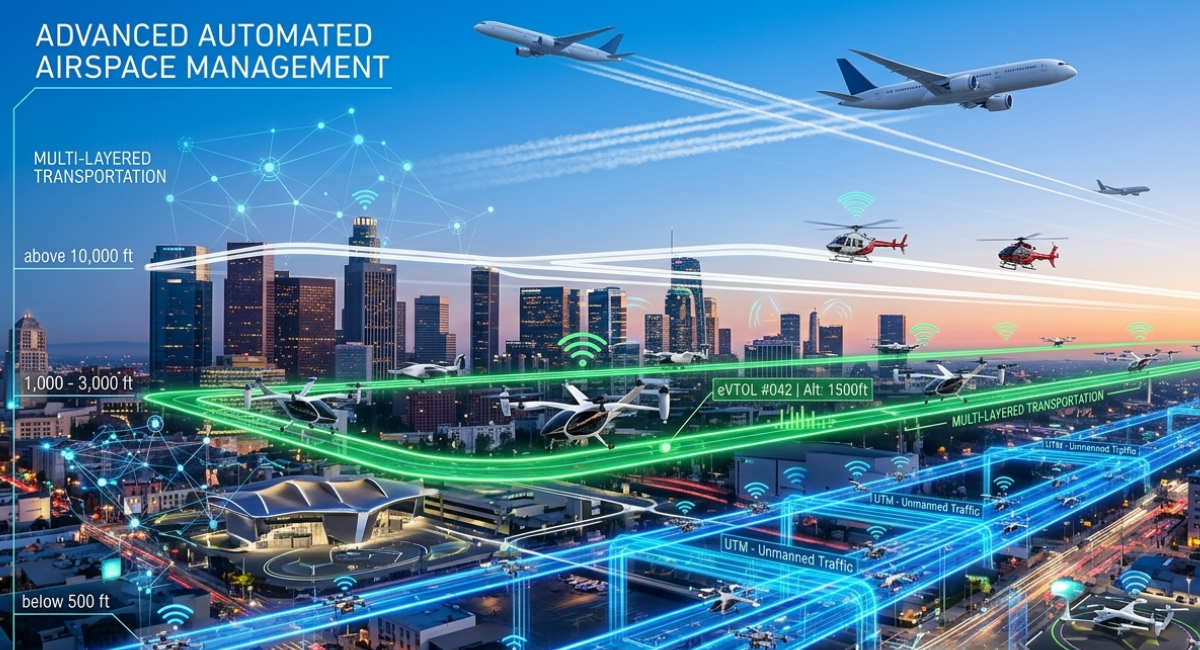
Right now, our airspace is a neatly organized layer cake. You’ve got commercial jets cruising at 30,000 feet, general aviation and helicopters hanging out in the 1,000 to 3,000-foot range, and hobbyist drones capped at 400 feet. It’s a system built on decades of rules and human controllers keeping things easy.
Adding thousands of flying taxis changes everything. These planes fly low, take off straight up, and there will be a lot of them in a small space. This isn’t just a few extra flights; it is a massive amount of traffic that would be too much for human air traffic controllers to handle. The biggest problem for flying cars isn’t just the batteries or the noise—it’s the computer systems.
We need to figure out how to build a smart, safe system that can manage thousands of vehicles at once without any crashes. Until we solve this traffic puzzle, these futuristic rides won’t be taking off.
The Challenge of Coordinating Flying Taxis, Helicopters, Drones, and Planes in the Same Sky
How do thousands of eVTOL aircraft share airspace with helicopters, drones, and planes without constant near-misses?This is the air traffic management problem. And it’s one of the biggest challenges eVTOL faces.
This guide explains how current air traffic works. Why eVTOL breaks the system. What technology solutions exist. And when we’ll have answers.
How Air Traffic Works Today
To understand the problem, we first need to look at how we manage the sky right now. It is actually a very organized system based on height.
The Basic Setup:
Think of the sky like a tall building with different floors (called “Classes”). Everyone has a floor where they are allowed to be:
- The Top Floors: Big airplanes fly very high up, usually above 18,000 feet.
- The Middle Floors: These are for planes near big or medium-sized airports.
- The Bottom Floors: This is where small airports and private planes operate, usually closer to the ground.
How a Flight Happens:
- The Plan: A pilot tells the “traffic police” (Air Traffic Control) where they want to go.
- The Permission: The controller tells the pilot it is safe to take off.
- The Path: The pilot stays at a specific height and follows a set path.
- The Watching: Controllers watch their screens every second to make sure planes stay far apart.
Why It Works (For Now):
This system works because everyone follows the rules and stays on their own “floor.” Most importantly, there aren’t that many planes in the sky at once. A big airport might handle 50 to 100 planes in an hour. This gives human controllers plenty of time to make safe decisions.
The current system was built for this amount of traffic. It simply wasn’t made to handle thousands of new flying taxis all at once.

The Problem: eVTOL Changes Everything
Now flying taxis are getting ready.
eVTOL aircraft operate at:
- 500-3,000 feet (low altitude)
- Vertical takeoff and landing (unpredictable paths)
- High frequency (many flights per hour)
- Dense spacing (multiple aircraft per area)
The math:
If Los Angeles has 10 vertiports. Each vertiport handles 200 flights per day. That’s 2,000 flights per day in LA alone.
Current system: 100 flights per hour maximum per airport.
eVTOL potential: 400-600 flights per hour across the city.
That’s 4-6x current capacity. In much more complicated airspace.
Why this breaks current system:
- Altitude overlap: eVTOL shares altitude with helicopters
- Density: Much more aircraft in same area
- Complexity: Vertical takeoff/landing needs special handling
- Coordination: Thousands of aircraft need real-time coordination
- Automation: Current system is manual. Can’t scale manually.
You can’t have a human air traffic controller managing 500 eVTOL aircraft. They’d lose track in seconds.
Integration Challenges Explained
Let’s understand the specific challenges:
Challenge number 1: Density
Too many aircraft. Not enough airspace.
Current system: Handles maybe 100 aircraft per hour in an area.
eVTOL future: Needs to handle 500+ aircraft per hour.
Solution: Need new system that handles density.
Challenge number 2: Altitude Conflict
eVTOL flies at same altitude as helicopters.
If helicopter is flying at 1,500 feet. eVTOL wants to fly at 1,500 feet. They can’t both be there.
Solution: Need clear separation or sophisticated deconfliction.
Challenge number 3: Unpredictable Paths
Airplanes have predictable routes. They follow airways.
eVTOL takes off vertically from anywhere. Lands vertically anywhere. Less predictable.
Solution: Need system that can handle dynamic paths.
Challenge number 4: Real-Time Coordination
Current system has humans making decisions. This works for 100 aircraft.
500+ aircraft? Humans can’t keep up.
Solution: Need automation. Computers need to coordinate.
Challenge number 5: Safety Redundancy
Current system has backup. If one controller loses track, another catches it. With thousands of eVTOL? Need multiple backup systems.
Solution: Need technology that ensures safety even with failures.
Challenge number 6: Integration with Existing System
eVTOL can’t operate separately. Must integrate with:
- Air traffic control
- Helicopter operations
- Drone regulations
- Airplane routes
Solution: Need system that bridges all aircraft types.
Technology Solutions: What’s Being Developed
Several technology approaches are being developed:
Solution number 1: UTM (Unmanned Traffic Management)
UTM is technology for managing drones.
What it does:
- Tracks all aircraft in real-time
- Detects conflicts automatically
- Suggests route changes
- Manages traffic flow
How it works:
- Every aircraft broadcasts position
- Central system tracks all positions
- Algorithm calculates safe spacing
- System suggests deviations
For eVTOL:
- UTM could expand to include eVTOL
- Drones use UTM now (up to 400 feet)
- eVTOL would use UTM above 400 feet
Status: FAA testing now. Could be ready for initial eVTOL use by 2027-2028.
Solution number 2: TFM (Traffic Flow Management)
Traditional system for airplanes. Being upgraded for eVTOL.
What it does:
- Plans routes for all aircraft
- Assigns departure times
- Assigns altitudes
- Manages flow
For eVTOL:
- Would need to accept thousands of aircraft
- Need new algorithms for density
- Need new protocols for vertical aircraft
Status: FAA developing standards now. Could integrate eVTOL by 2027-2028.
Solution number 3: ADSB Out/In (Automatic Dependent Surveillance Broadcast)
System where every aircraft broadcasts its position.
What it does:
- Aircraft transmits: position, altitude, speed, direction
- All other aircraft receive this data
- System builds picture of all aircraft
- Conflicts detected automatically
For eVTOL:
- All eVTOL would have ADS-B Out
- Would transmit position constantly
- Other aircraft would see them
- Automated separation maintained
Status: Already required for many aircraft. Expanding to eVTOL.
Solution number 4: Detect and Avoid (DAA)
Technology where aircraft avoid each other automatically.
What it does:
- Aircraft detects other aircraft nearby
- Algorithm calculates collision risk
- Aircraft automatically adjusts course
- Avoids collision without human input
For eVTOL:
- Each eVTOL would have DAA system
- Would detect other aircraft
- Would avoid automatically
- Reduces human pilot workload
Status: Being tested now. Could be standard by 2028.
Solution number 5: Integrated Airspace Management System (IAMS)
New system combining all the above.
What it does:
- Integrates UTM (drones)
- Integrates TFM (flow management)
- Integrates ADS-B (position tracking)
- Integrates DAA (automatic avoidance)
- Manages all aircraft types together
For eVTOL:
- Single system for eVTOL coordination
- Works with helicopters, drones, planes
- Fully automated
- Handles thousands of aircraft
Status: Concept stage. FAA researching. Could be ready by 2030-2032.
Solution number 6: Cloud-Based Traffic Management
All aircraft data in cloud. Real-time coordination.
What it does:
- Every aircraft uploads position to cloud
- Cloud system has complete picture
- Algorithms optimize routes
- Sends instructions to aircraft
- Updates continuously
For eVTOL:
- Perfect for high-density operations
- Handles thousands of aircraft
- Can optimize traffic flow city-wide
- Reduces conflicts
Status: Technology exists now. Being adapted for aviation. Could be ready by 2028-2030.
Where We Are with Flying Taxis
The plan to get flying taxis (eVTOLs) into the sky is happening in stages. Here is the timeline for how we will manage the traffic:
2024–2025: Testing the Waters
Right now, we are just testing things. Companies like Joby and Archer are flying their first taxis using the same rules as helicopters. Human controllers watch them on radar, and they follow old-fashioned safety steps. It isn’t fully automated yet, but it is safe.
2026–2027: Adding More Technology
As more flying taxis start to fly, we will stop relying only on humans. We will start using new computer systems to track them. These systems help taxis “see” each other to avoid crashes. Humans are still doing the hard work, but computers are starting to help.
2028–2030: Computers Take the Lead
By this time, most of the coordination will be handled by computers. Smart systems in the “cloud” will talk to the taxis and tell them where to go. Humans will still be there to supervise, but the computers will do most of the heavy lifting.
2030 and Beyond: The Future System
The goal for 2035 is to have a sky where thousands of flying taxis, drones, and airplanes all fly together perfectly. The system will be fully automated, meaning computers will plan the routes and keep everyone safe instantly. This is the big goal we are working toward.
The Role of Different Technologies
Let me explain who does what:
FAA’s Role:
- Sets standards
- Approves procedures
- Certifies systems
- Oversees safety
- Enforces regulations
Technology Companies’ Role:
- Develop UTM systems
- Develop DAA software
- Develop cloud platforms
- Develop communication systems
Aircraft Companies’ Role:
- Install required equipment
- Follow procedures
- Integrate with systems
- Report data
Airports/Vertiports’ Role:
- Coordinate ground operations
- Manage departures/arrivals
- Interface with air traffic control
Pilots’ Role (Human):
- Fly aircraft
- Monitor systems
- Override if needed
- Report issues
Timeline: When Will This Be Ready?
2026-2027: Basic operations
- Human ATC manages eVTOL
- Limited density (10-50 flights per hour)
- Traditional procedures
- Safe but slow
2027-2028: Technology integration begins
- UTM expands to include eVTOL
- ADS-B mandatory for all eVTOL
- DAA systems tested
- Density increases (100-200 flights per hour)
2028-2030: Advanced automation
- Most coordination automated
- DAA standard
- Cloud systems operational
- Density increases significantly (300-500 flights per hour)
2030-2035: Mature system
- Fully automated coordination
- Seamless integration
- High density possible
- Autonomous eVTOL possible
2035+: Future state
- Autonomous eVTOL flying themselves
- AI-optimized routing
- Thousands of aircraft coordinated
- Network effects (more aircraft = better system)
What Could Go Wrong?
Even with a good plan, there are a few things that could slow down the “flying car” future:
Risk 1: The technology is late. If the smart computer systems aren’t ready by 2028, these flying taxis will have to wait on the ground. Right now, things are moving on time, but it could still take longer than expected.
Risk 2: Safety worries. If there are any crashes or close calls early on, people might be too scared to use them. Companies are working hard to make them safe, but there is always a small risk.
Risk 3: Government rules. The government (FAA) has to approve every step. They are moving faster than usual, but government work can be very slow and full of paperwork.
Risk 4: Fighting for space. Helicopter pilots have used the low sky for a long time. They might not want to share their space with thousands of new flying taxis. Both groups need to learn to get along.
Risk 5: Systems that don’t talk. If a taxi from one company cannot “talk” to a taxi from another company, they might get too close to each other. We need one common language for all flying taxis to stay safe.
Amit Opinion: Will The System Be Ready?
Here’s my honest opinion.
Can we handle thousands of eVTOL safely?
Yes. Technology exists today to coordinate thousands of aircraft safely.
Will it be ready by 2026-2027 for initial launch?
Probably not fully. But partial solutions will exist. Initial operations will be limited (10-50 flights per hour). Safe but slow.
Will it be ready by 2030-2035 for full market?
Probably yes. Technology will mature. Automation will increase. System will handle thousands of aircraft.
My prediction:
2026-2027: Safe but limited. Maybe 10-20 flights per hour per city.
2030: Better. Maybe 200-300 flights per hour.
2035: Mature. Thousands of flights possible.
Common Myths About Flying Taxis
There are many wrong ideas about how flying taxis will work. Here are the facts:
Myth #1: “We can’t fly thousands of planes safely.”
The Truth: We actually have the technology to do this right now. The real question is how long it will take to set everything up and start using it.
Myth #2: “Flying taxis will have their own private space.”
The Truth: They won’t have their own “road” in the sky. They will have to share the same space with helicopters. Learning how to share that space safely is the big challenge.
Myth #3: “Humans will guide every flying taxi by hand.”
The Truth: Humans cannot keep track of thousands of taxis at once. We need smart computers to do the work automatically. These systems are being built right now.
Myth #4: “We have to throw away our old system and start over.”
The Truth: We don’t need to build a whole new system from scratch. We are just making our current system better by adding new technology to it.
Myth #5: “The problem is already fixed.”
The Truth: We have some answers, but not all of them. A full system that works perfectly won’t be ready until somewhere between 2028 and 2030.
Conclusion
Air traffic management is one of the biggest challenges for eVTOL. Current system works for low density. eVTOL needs high density coordination. Several technology solutions exist. UTM, TFM, ADS-B, DAA, cloud systems.
Timeline:
2026-2027: Basic operations with limited automation
2028-2030: Advanced automation. Moderate density.
2030-2035: Mature system. High density.
Technology will be ready. But implementation takes time.
This is good news. Means we’re thinking comprehensively about safety.
Learn More About eVTOL Operations
Read our related articles:
- FAA Certification – Why certification matters
- Vertiports – Where eVTOL will operate
- Joby Air Space Intelligence Partnership – Real airspace solutions
- Battery Technology – Technical foundations
Questions About eVTOL Air Traffic Management?
Email us: contact@airtaxicentral.com or amit@airtaxicentral.com