Urban transportation is shifting from crowded city streets to the skies. Cities around the world face growing traffic problems and need cleaner travel options.
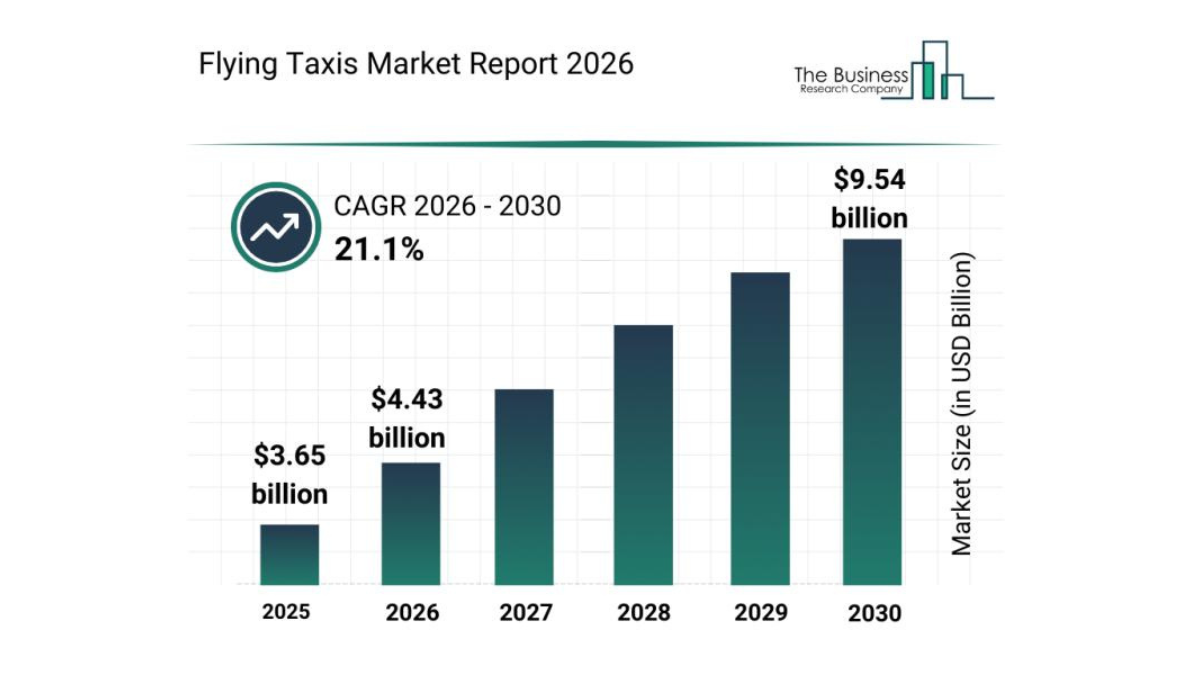
Because of this, electric vertical takeoff and landing (eVTOL) aircraft are moving closer to reality. According to the latest reports the global flying taxi market will reach a value of $9.53 billion by the year 2030. This growth represents a massive 21.1% compound annual growth rate (CAGR) over the next few years.
Why Flying Taxis Are Growing So Fast
There are a few main reasons why this new market is growing so quickly. First, big companies are spending a lot of money to build these electric aircraft. Second, new computer programs are making flights much safer. These smart systems can fly the aircraft on their own, so companies will not need to find and hire as many highly trained pilots.
People also want cleaner ways to travel. Because these air taxis run on electricity, they do not produce dirty exhaust smoke, which helps keep city air clean. To make this all work, companies are building special landing pads where these taxis can take off and land safely. At the same time, governments are writing clear safety rules to make sure these flying taxis are completely safe for everyday passengers to use.

Major Industry Players Leading the Race
The flying taxi industry features a mix of aerospace giants and modern technology firms. Major businesses working in this space include Hyundai Motor Company, The Boeing Company, Airbus SE, and Zhejiang Geely Holding Group. Other names helping to push this technology forward include Textron Inc., Vertical Aerospace, Archer Aviation, Joby Aviation, Wisk Aero, Volocopter, and Ehang Holding Limited.
Instead of working completely alone, these industry leaders are joining forces with software experts. For example, the Indian aviation startup ePlane signed a partnership with Tata Consultancy Services. The ePlane Company wants to use the computing, data analytics, and digital tools from Tata Consultancy Services to optimize battery life and improve passenger routes across major cities.
Key Trends: From Commuter Shuttles to Firefighting Vehicles
As the market grows, companies are finding creative ways to use electric aircraft. While most people think of flying taxis as simple passenger shuttles, these vehicles are also being designed for emergency rescue missions.
Hyundai Motor Company has been a major highlight in this sector through its advanced air mobility division, Supernal. At major trade shows, Supernal showcased its impressive S-A2 electric flying taxi prototype. The Supernal S-A2 is an eight-rotor vehicle designed to cruise quietly at 120 miles per hour.
It targets short city trips to help people skip heavy ground traffic completely. Other international startups are taking similar designs and building high-payload versions meant to carry heavy equipment to fight fires in hard-to-reach areas.
How the Flying Taxi Industry is Segmented
The global industry is split into distinct categories depending on the needs of different cities:
- By Seating Capacity: Single-seat aircraft for personal travel, double-seat vehicles for short commutes, and multi-seat designs for public air shuttle services.
- By Aircraft Design: Multicopters and quadcopters that use multiple rotors to lift off vertically without needing a long runway.
- By Power Source: Pure electric battery systems, parallel hybrid engines, and turboelectric propulsion.
- By Travel Distance: Intracity flights to move across a single metropolitan area, and intercity flights to connect neighboring cities.
With massive financial backing and constant improvements in battery technology, flying taxis are no longer a concept from science fiction. The next few years will determine how quickly these electric aircraft become a regular part of daily city transit.