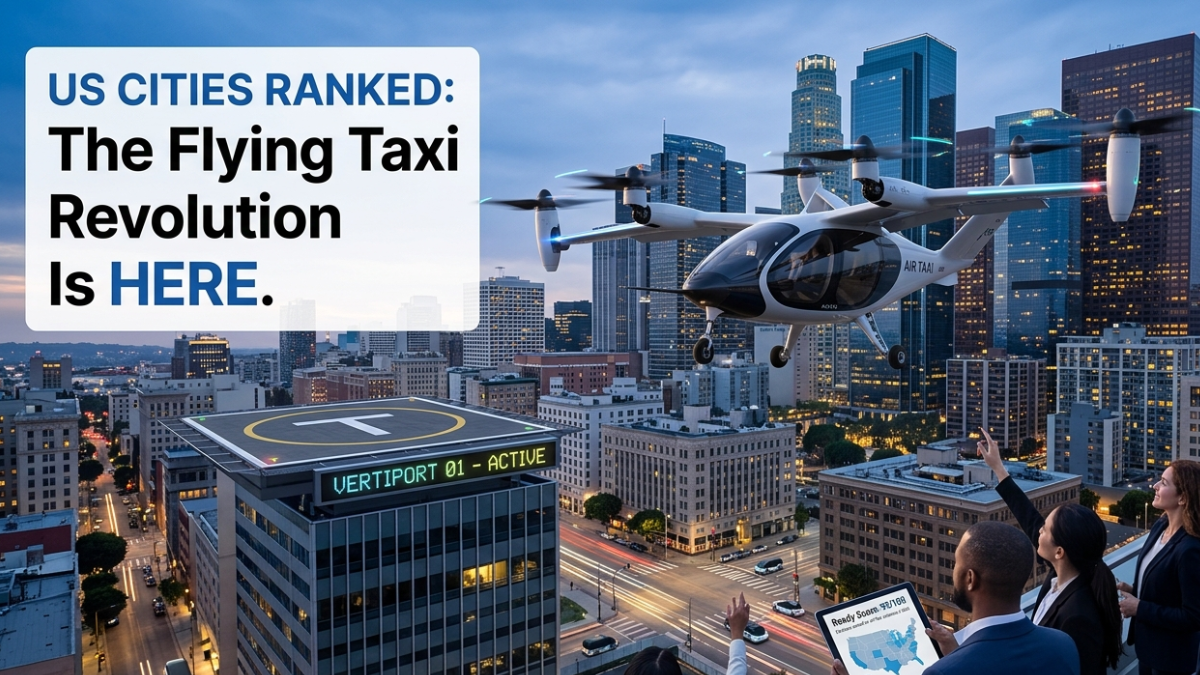
While Dubai is leading the way globally, the United States isn’t far behind in the race for the sky. A US flying taxi launch is now a matter of a question “when” as major cities across the country prepare for a total transportation makeover. However, not every American city is moving at the same speed.
Some big cities like New York and Los Angeles are already moving fast. They are building landing pads and fixing their laws right now. But in other places, it might be a long time before you see a flying taxi in the sky. To see which cities are winning the race, we have ranked the top 15 US cities. We looked at who has the best buildings, which local governments are helping out, and—most importantly—which cities have the worst traffic that needs a solution
How We Ranked These Cities
Before showing you the rankings, let’s look at the five key factors that decide if a city is truly ready for the future of flight:
- Infrastructure Readiness: Does the city have space for vertiports? Can the local power grid handle fast-charging electric planes?
- Regulatory Environment: Is the local government working with the FAA? Can they pass new landing laws quickly?
- Market Demand: Is there a clear need for faster travel to airports or business hubs?
- Population & Wealth: Larger, wealthier cities have the customer base needed to pay for premium $200+ rides.
- Traffic Pain: The worse the traffic, the more people will want to fly over it.
3 Things to Keep in Mind
1. Our Professional Analysis: While companies like Joby and Archer have picked their first partners, this list is our prediction based on real-world infrastructure data.
2. Rankings Can Change: If a city gets new funding or a faster permit, they could jump to the top of the list overnight.
3. The Real Timeline: Most US cities won’t see full commercial service until 2027 or 2028. Dubai will still be the world’s first “test case” in late 2026.
The Top 15 US Cities For Flying Taxis
How We Ranked These Cities
- Infrastructure: Space for landing pads and enough power for fast-charging.
- Government Support: Local leaders pushing for new flight laws.
- Market Demand: High traffic areas with people willing to pay for speed.
- Wealth & Population: Enough customers to keep the taxis flying.
Number 1: Los Angeles, California
Readiness Score: 95/100
Los Angeles is the absolute best city for flying taxis. It is spread out, meaning driving takes forever. A flying taxi can turn a two-hour drive into a 20-minute flight. With perfect weather and plenty of wealthy travelers, LA is the top target for companies like Joby and Archer.
Top Route: Airport (LAX) to Downtown | Expected: 2027-2028

Number 2: New York City, New York
Readiness Score: 85/100
NYC has the most people and the most money. Traffic to JFK airport is a nightmare, so demand is huge. The challenge is the crowded space—it’s hard to find places to land between skyscrapers, but the money here is too big for companies to ignore.
Top Route: JFK Airport to Manhattan | Expected: 2027-2028
Number 3: San Francisco Bay Area, California
Readiness Score: 80/100
The tech capital of the world is perfect for innovation. Since water separates the Bay Area, flying is much faster than using bridges. Tech workers with high incomes will likely be the first regular users here.
Top Route: SFO Airport to Downtown | Expected: 2028-2029
Number 4: Dallas-Fort Worth, Texas
Readiness Score: 78/100
Dallas has tons of flat land and very business-friendly laws. It’s a booming area where people drive long distances. Building landing pads here is much easier and cheaper than in New York.
Top Route: DFW Airport to Downtown Dallas
Number 5: Chicago, Illinois
Readiness Score: 76/100
Chicago is a major business hub. While it has the infrastructure, the “Windy City” faces weather challenges. Snow and high winds in the winter will make flying harder than in California.
Number 6: Miami, Florida
Readiness Score: 75/100
Miami is a tourist dream with perfect flying weather. Wealthy visitors will love the experience of skipping traffic to get to the beach. The Florida government is very supportive of this tech.
Number 7: Atlanta, Georgia
Readiness Score: 74/100
Atlanta has the world’s busiest airport. People landing there need a fast way into the city, making it a perfect market. It’s a spread-out city with plenty of room to grow.
Number 8: Boston, Massachusetts
Readiness Score: 72/100
Boston is a wealthy city with many business travelers. It’s a bit cramped like NYC, but the demand for fast travel to the airport will drive the service forward.
Number 9: Seattle, Washington
Readiness Score: 70/100
Home to Amazon and Microsoft, Seattle has the right customers. The main issue is the constant rain and clouds, which can ground flights more often than in other cities.
Number 10: Denver, Colorado
Readiness Score: 68/100
Denver is growing fast. The “thin air” at high altitudes is a technical challenge for the aircraft, but the long drive to the airport makes it a great spot for air taxis.
Number 11: Phoenix, Arizona
Readiness Score: 67/100
Phoenix is flat, sunny, and sprawling. It’s perfect for flying, though engineers have to watch how the extreme summer heat affects the aircraft batteries.
Number 12: Orlando, Florida
Readiness Score: 65/100
Orlando is all about Disney and theme parks. Millions of families would pay for a fast flight to their hotels. It’s a huge market, but mostly for tourists.
Number 13: Las Vegas, Nevada
Readiness Score: 63/100
Vegas loves new gadgets. Tourists will use these to hop between the airport and the casinos. The airspace is very busy, so it will take time to organize.
Number 14: Washington DC
Readiness Score: 62/100
DC has plenty of wealthy business people, but security is the biggest hurdle. Flying near the White House or Capitol means very strict rules and longer wait times for approval.
Number 15: Austin, Texas
Readiness Score: 61/100
Austin is a tech-friendly, fast-growing city. While it is still building up its infrastructure, it is one of the most exciting future markets for air travel in the South.
My assessment: Austin will get flying taxis. Growing city. Tech-friendly. But still developing infrastructure. Later than established cities.
Summary Table: Top 15 US Cities
| Rank | City Hub | Readiness Score | Main Partners | Expected Launch |
|---|---|---|---|---|
| 01 | Los Angeles, CA | 95/100 | Joby, Archer | 2027-2028 |
| 02 | New York City, NY | 85/100 | Joby, Beta, Archer | 2027-2028 |
| 03 | San Francisco, CA | 80/100 | Wisk, Joby, Archer | 2028-2029 |
| 04 | Dallas-Fort Worth, TX | 78/100 | Archer, Wisk, Beta | 2028-2030 |
| 05 | Chicago, IL | 76/100 | United Airlines, Archer | 2028-2030 |
| 06 | Miami, FL | 75/100 | Lilium, Archer | 2028-2030 |
| 07 | Atlanta, GA | 74/100 | Delta, Joby | 2029-2031 |
| 08 | Boston, MA | 72/100 | Beta, Joby | 2029-2031 |
| 09 | Seattle, WA | 70/100 | Joby, Beta | 2029-2031 |
| 10 | Denver, CO | 68/100 | United, Archer | 2030-2032 |
| 11 | Phoenix, AZ | 67/100 | Skyports, Joby | 2030-2032 |
| 12 | Orlando, FL | 65/100 | Lilium, Ferrovial | 2030-2032 |
| 13 | Las Vegas, NV | 63/100 | Joby, Archer | 2031-2033 |
| 14 | Washington DC | 62/100 | Joby, Archer | 2032-2035 |
| 15 | Austin, TX | 61/100 | Wisk, Archer | 2031-2033 |
Source: Data compiled from 2026 infrastructure reports and municipal eVTOL partnership agreements.
What Makes a City “Ready” for Flying Taxis?
Let me explain what we looked at for each city:
Infrastructure (30 points):
- Space for vertiports (vertical landing pads)
- Modern power grid (charging aircraft)
- Good air traffic control systems
- Modern airport infrastructure
Regulations (25 points):
- City/state government support
- Fast permit approval
- Federal cooperation (FAA)
- Forward-thinking officials
Market Demand (25 points):
- Population size
- Long distance transportation needs
- Wealth of residents (can afford $200-400)
- Tourism (visitors willing to pay)
Population & Wealth (15 points):
- Number of potential customers
- Income levels
- Business activity
- Corporate headquarters
Geography & Weather (5 points):
- Space for vertiports
- Weather conditions
- Terrain challenges
- Airspace complexity
Cities scoring 70+ are ready for 2029-2030 launches.
Cities scoring 80+ are ready for 2027-2028 launches.
When Will Your City Get Flying Taxis?
Late 2026: Dubai launches (not US)
2027-2028 (First US wave): Los Angeles, New York City
2028-2029 (Second wave): San Francisco, Dallas, Chicago, Miami
2029-2031 (Third wave): Atlanta, Boston, Seattle
2030-2032 (Fourth wave): Denver, Phoenix, Orlando
2031-2033 (Fifth wave): Las Vegas, Austin
2032-2035 (Later waves): Washington DC, smaller cities
2035+: Rural areas, smaller towns
My Honest Opinion
Los Angeles will be FIRST US city. Most ready. Joby or Archer will launch here in 2027-2028.
New York follows closely. Big demand but harder infrastructure.
San Francisco, Dallas, Chicago, Miami follow in 2028-2030. By 2035, most major US cities will have flying taxis. By 2040, flying taxis are normal in 50+ US cities.
Flying Taxis in the US: Frequently Asked Questions
Question: Will my city get flying taxis soon?
Answer: If you live in a major hub like Los Angeles, New York, or Miami, you could see them by 2027 or 2028. For other large cities (over 1 million people), the goal is 2030 to 2032. Smaller cities will likely have to wait until 2035 or later when the technology becomes cheaper and more common.
Question: Why isn’t my city ranking higher on the “Readiness” list?
Answer: Usually, it’s one of three things: weather, money, or space. Cities with very cold winters (lots of ice) or very crowded skies are harder to start in. Also, companies launch first where there are enough people willing to pay premium prices to justify the cost of building the landing pads.
Question: Is it going to be as loud as a helicopter?
Answer: Not at all. These are “eVTOLs” (electric planes), and they are designed to be much quieter. While a helicopter has one giant, noisy engine, these use many small electric motors. From the ground, a flying taxi sounds more like a soft “hum” or a swarm of bees rather than a thumping helicopter
Question: How do I actually get on one?
Answer: It will feel just like calling an Uber or Lyft. You will open an app, book a seat, and walk to a nearby “vertiport” (a landing pad on top of a parking garage or building). You won’t need to go to a giant airport for every flight.
Question: Can I buy property near future vertiports to make money?
Answer: Yes, but it’s a bit of a gamble right now. Exact locations are still being kept secret for business reasons. However, looking at major transit hubs—like train stations or luxury malls—is a good hint. Properties within a 10-minute walk of a future vertiport will likely see a “Connectivity Premium,” meaning their value could jump significantly.
Question: Will flying taxis take away jobs from Uber drivers or pilots?
Answer: Actually, they will create more jobs. We will need thousands of new commercial pilots specifically trained for these aircraft. We also need mechanics, ground crews, and people to manage the “vertiport” stations. While it might take some high-end trips away from car services, it mostly creates a whole new category of work.
Question: Can I invest in this technology right now?
Answer: You can’t usually “buy a taxi,” but you can invest in the companies building them. Companies like Joby Aviation (JOBY) and Archer Aviation (ACHR) are publicly traded on the stock market. When they expand to new cities and start making a profit, their shareholders benefit.
Question: What about my privacy if these are flying over my house?
Answer: This is a big topic for 2026. Regulators have set “flight corridors,” which are like invisible highways in the sky. Taxis won’t just zig-zag over random backyards; they will follow specific paths—usually over existing big roads or industrial areas—to keep noise and privacy issues as low as possible.
Question: Can I fly a flying taxi in bad weather?
Answer: For now, the rules are “Safety First.” If there is heavy rain, thick fog, or high winds, flights will be grounded, just like at a normal airport. As the tech gets better, they will be able to fly in tougher conditions, but expect some “weather delays” in the early years.
Questions About US Flying Taxis?
Email us: contact@airtaxicentral.com or amit@airtaxicentral.com
Follow us:
- Twitter: @AirTaxiCentral
- Instagram: @airtaxicentral
- YouTube: @AirTaxiCentral