Most air taxi companies are building aircraft with a pilot inside. Wisk Aero is doing something completely different. Wisk is building a flying taxi that has no pilot at all — not in the cockpit, not remotely controlling it in real time. The aircraft flies on its own, with a human operator on the ground keeping an eye on things.
This is the Wisk Aero Generation 6, also called the Gen 6. And in May 2026, Wisk reached a milestone that very few eVTOL companies have hit: two fully autonomous aircraft flying at the same time in an active flight test program.
Here is everything you need to know about the Gen 6, what makes it different, and why this aircraft could change the way cities think about transportation.
Table of Contents
- What Is the Wisk Aero Gen 6?
- Two Aircraft, One Goal: Inside Wisk’s Dual-Flight Test Program
- Gen 6 Specs: What This Aircraft Can Actually Do
- No Pilot Inside — How Does That Actually Work?
- Where Does FAA Certification Stand Right Now?
- Texas Is the First Market — Here Is the Plan
- Wisk Gen 6 vs. Joby, Archer, and Others
- When Can You Actually Ride One?
- Final Thoughts
What Is the Wisk Aero Gen 6?
Wisk Aero is a company based in Mountain View, California. Wisk is fully owned by Boeing, one of the largest aircraft manufacturers in the world. Wisk has been working on autonomous flying taxis for over a decade.
The Gen 6 is the sixth aircraft Wisk has ever built — and the first one being put forward for FAA type certification. That means this is not a prototype or a test concept. This is the real product that Wisk wants to certify and put into commercial passenger service.
Before the Gen 6 was even built, Wisk had already completed more than 1,750 test flights across its previous five generations of aircraft. All of that data went into designing the Gen 6. No other eVTOL company in the world has flown six generations of the same aircraft type.
Quick Fact: The first Gen 6 aircraft made its maiden hover flight on December 16, 2025, at Wisk’s test facility in Hollister, California. The aircraft followed a pre-programmed flight plan — no human was flying it.
Two Aircraft, One Goal: Inside Wisk’s Dual-Flight Test Program
On May 4, 2026, Wisk tested its second Gen 6 aircraft for the first time. The flight took place at Wisk’s flight test facility in Hollister, California. The aircraft, registered as N607WA, completed vertical takeoff, hover, and what engineers call “chirp” maneuvers. These are controlled movements that help measure how the aircraft’s structure handles different loads and how the flight controls respond.
This happened just four and a half months after the first Gen 6 flew in December 2025. Most eVTOL companies take much longer to build and fly a second aircraft.
Wisk CEO Sebastien Vigneron said: “Seeing the second Gen 6 aircraft take to the skies is a proud moment for Wisk. This pace of execution is exactly what is required to meet the rigorous safety standards of commercial aviation. Having multiple aircraft in flight testing allows us to move faster, learn quicker, and stay on the leading edge of autonomous aviation. Every flight provides crucial data that matures our aircraft and autonomous system, bringing us one step closer to delivering a certified, autonomous air taxi service.”

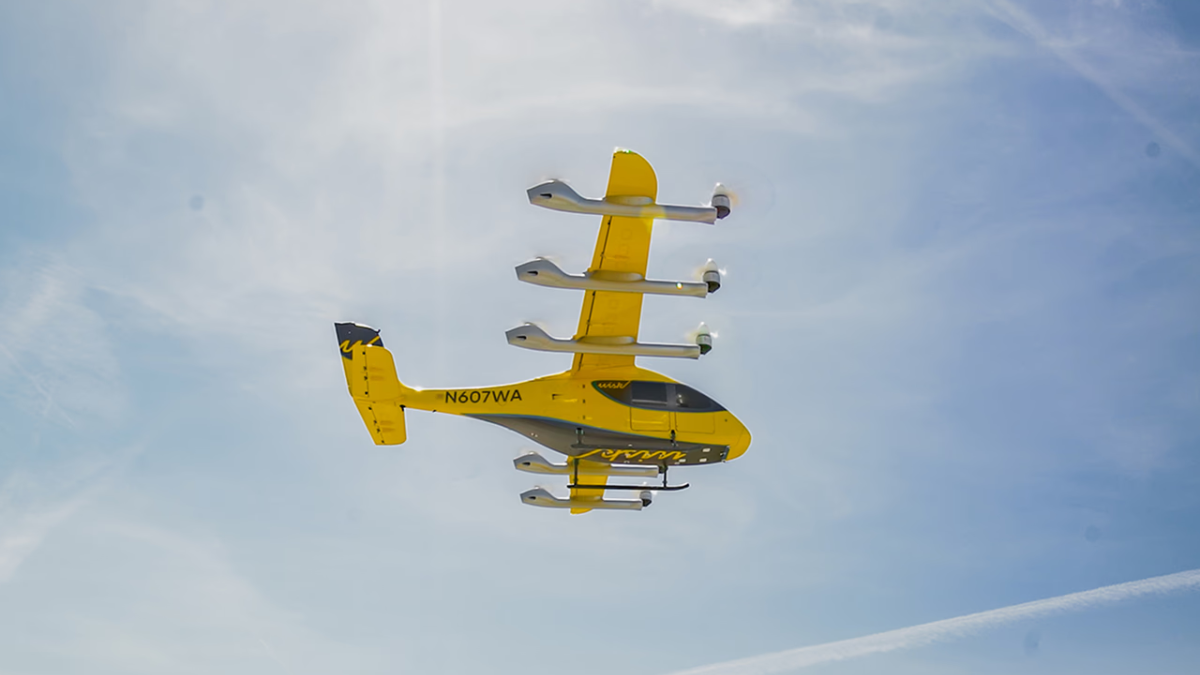
This increase in flight test capacity directly supports Wisk’s path to commercialization, along with the U.S. Department of Transportation’s selection of Wisk’s partner, the Texas Department of Transportation (TxDOT), for the Electric Vertical Takeoff and Landing (eVTOL) and Advanced Air Mobility (AAM) Integration Pilot Program (eIPP). Wisk will use its autonomous systems and aircraft to drive the program’s operational execution, conducting real-world flight operations in the U.S. National Airspace.
Why does having two aircraft matter so much? Because FAA certification is driven by data. The more flights Wisk completes, the more data Wisk collects. The more data Wisk collects, the faster Wisk can prove to the FAA that the aircraft is safe. With two aircraft flying at the same time, Wisk can now run parallel test campaigns — effectively doubling the speed at which Wisk builds its certification case.
Gen 6 Specs: What This Aircraft Can Actually Do
The Gen 6 is not just impressive because it flies itself. The technical specs are genuinely competitive with every other air taxi being developed right now.
| Spec | Detail |
|---|---|
| Passengers | 4 passengers + luggage |
| Cruise Speed | 120 knots (138 mph / 222 km/h) |
| Range | 90 miles (145 km) |
| Service Altitude | 2,500 to 4,000 feet |
| Wingspan | 50 feet (15 metres) |
| Propellers | 12 total — 6 lift rotors, 6 convertible lift/cruise rotors |
| Battery | 120 kWh |
| Charging Time | 15-minute fast DC charge |
| Pilot | None onboard — fully autonomous |
| Transition to Forward Flight | Approximately 30 seconds |
The wing spans 50 feet and sits in a high position on the aircraft. This gives the aircraft more stability and also improves the view for passengers inside. The cabin is designed to feel like a premium car interior — comfortable seats, good window visibility, Wi-Fi, and charging ports.
The 15-minute fast charge is a standout feature. Most electric aircraft take much longer to recharge. If Wisk can maintain this in commercial operations, the Gen 6 can complete multiple short trips per day without long gaps between flights. That is important for making the economics of an air taxi service actually work.
No Pilot Inside — How Does That Actually Work?
This is the part that makes Wisk Aero different from every other major air taxi company in the United States right now. Companies like Joby Aviation, Archer Aviation, and Beta Technologies are all building aircraft where a human pilot sits in the cockpit. Wisk is building an aircraft where no one sits in the cockpit — because there is no cockpit.
So how does the Gen 6 fly safely?
The aircraft uses a combination of advanced computers, sensors, radar, and software to navigate its route. The Gen 6 follows pre-programmed flight paths and can detect and avoid other aircraft on its own. A ground-based operator called a Multi-Vehicle Supervisor monitors the flight and can take control if needed. One operator on the ground can supervise multiple aircraft at the same time.
The safety systems are built in layers. The Gen 6 has triple-redundant autonomous flight systems, 12 independent electric motors, and a whole-airframe parachute for emergency situations. If any single system fails, a backup takes over immediately.
Wisk Vice President of Certification Cindy Comer explained the reasoning behind this approach: “We know that eventually, to scale, this industry needs to have autonomy. We could build an aircraft and put pilots in it, and then later go autonomous. But that would mean certifying twice.” Wisk chose to certify autonomy from the very beginning.
Where does the official safety approval stand?
Getting the Federal Aviation Administration (FAA) to clear these air taxis for paying passengers is the hardest part of the whole business. It takes a massive amount of time, paperwork, and money. But the company is actually much further along than most people think.
Right now, they are in the deep testing phase. Instead of just showing the government plans on paper, Wisk is using real flight data to prove that their 6th-generation aircraft is completely safe to fly in any kind of weather or situation. This is a big deal because it is the first time in U.S. history that an aircraft with no pilot onboard is trying to get certified for passengers. Because this has never been done, there is no official rulebook yet.
Wisk is actually helping the FAA and NASA write the safety rules for the future. To do this, they are flying two test aircraft to push the boundaries—taking them faster, higher, and through tougher maneuvers. Their biggest focus right now is perfecting the trickiest part of the flight: smoothly changing from hovering like a helicopter to flying fast like an airplane.
Texas Is the First Market — Here Is the Plan
In March 2026, the U.S. Department of Transportation selected the Texas Department of Transportation (TxDOT) for the FAA’s eVTOL Integration Pilot Program, known as the eIPP. Wisk Aero was named as TxDOT’s primary private-sector eVTOL partner.
The eIPP is a White House-backed program that allows eVTOL aircraft to begin real-world operations in live U.S. airspace — even before full FAA type certification is complete. This means Wisk can start collecting real operational data while the certification process is still ongoing.
Houston is Wisk’s primary launch market. Los Angeles and Miami are also planned for later expansion.
The Texas program will run in phases. In the first phase, Wisk will operate conventional piloted aircraft on eVTOL routes. This lets Wisk test the route infrastructure, airspace integration, and its SkyGrid airspace management platform — all before the Gen 6 starts flying passengers. In the advanced phase, operations will scale to the Gen 6 aircraft itself, giving the FAA high-frequency data to support final certification.
Wisk’s subsidiary SkyGrid provides the Strata airspace management platform. This software helps manage the flow of autonomous aircraft in shared airspace — a critical part of making autonomous air taxis safe in busy city skies.
Wisk Gen 6 vs. Joby, Archer, and Others
It is fair to ask: how does the Gen 6 compare to the competition?
| Company | Aircraft | Pilot | Passengers | Speed | Target Launch |
|---|---|---|---|---|---|
| Wisk Aero | Gen 6 | No pilot (autonomous) | 4 | 138 mph | 2030 |
| Joby Aviation | S4 | 1 pilot | 4 | 200 mph | 2026 |
| Archer Aviation | Midnight | 1 pilot | 4 | 150 mph | 2026 |
| Beta Technologies | ALIA | 1 pilot | 5 | 170 mph | 2026–2027 |
Joby, Archer, and Beta Technologies are all targeting commercial service much sooner — in 2026 or 2027. Wisk is targeting 2030. But the trade-off is significant. Joby, Archer, and Beta still need a human pilot for every single flight. Wisk does not.
A piloted air taxi has one major limitation: you always need a trained, certified pilot. That costs money and limits how fast a company can scale its service. An autonomous air taxi removes that constraint entirely. One ground operator can oversee multiple aircraft at once. Over time, this makes autonomous air taxis far cheaper to operate than piloted ones.
Wisk’s bet is that being the first to certify autonomous flight will give the company a long-term advantage that no piloted air taxi company can easily match or copy.
When Can You Actually Ride One?
Wisk has set a commercial service target of 2030. That is four years from now. The timeline makes sense when you understand how much testing is still ahead.
The current flight test program is working through the transition corridor — the phase where the aircraft moves from hovering to flying like a fixed-wing plane at full cruise speed. This is technically demanding and requires a large amount of data before the FAA is satisfied.
After flight envelope testing is complete, Wisk still needs to complete certification compliance testing, manufacturing certification, and air carrier certification. Each step requires a separate FAA approval.
The eIPP Texas program runs in parallel. If real-world operations in Texas go well, it could build the FAA’s confidence in the Gen 6 and shorten the overall path to full certification. Houston will likely be the first city where paying passengers can board a Gen 6, with Los Angeles and Miami to follow.
Wisk has not confirmed ticket pricing yet, but the long-term goal is to make air taxi rides competitive with rideshare prices as the fleet scales up and operational costs come down.
Amit’s Opinion
While a 2030 launch target might make Wisk look like a laggard compared to Joby or Archer’s 2026 timelines, playing the long game is actually Wisk’s greatest strength.
By skipping the intermediate “piloted” phase, they are absorbing massive regulatory friction upfront so they don’t have to redesign and re-certify an entirely new system later.
The recent addition of a second Gen 6 test vehicle shows they have the capital and discipline to brute-force the data collection the FAA demands.
In the end, the commercial winner won’t be the company that flies passengers first—it will be the company that scales first. Without the burden of pilot wages and pilot shortages, Wisk’s unit economics are going to be incredibly tough for competitors to match when 2030 rolls around.
Final Thoughts
Wisk Aero is not the fastest company in the air taxi race. Joby and Archer are already doing public demonstration flights in New York City and targeting service launches this year. Wisk will not have a commercial product until 2030.
But Wisk is playing a completely different game.
Every other major eVTOL company in the United States is building a next-generation helicopter with a quieter engine and a pilot in the seat. Wisk is building something that has never existed before: a fully autonomous passenger aircraft certified to commercial aviation safety standards.
The Gen 6 is not just a new type of vehicle. It is potentially a new category of aviation altogether.
The fact that two Gen 6 aircraft are now flying simultaneously — just a few months after the first one left the ground — shows that Wisk is executing at a serious and disciplined pace. Boeing’s backing gives Wisk the financial strength to see this through a certification process that could take several more years.
If Wisk succeeds, the air taxi industry looks very different. The cost of operating an air taxi service drops dramatically when you remove the pilot from the equation. That changes the economics of the entire industry — not just for Wisk, but for every company that follows.
That is why the Gen 6 matters. Not because it will fly passengers next month. But because it is the aircraft that could prove autonomous air travel is possible — and in doing so, change everything that comes after it.